
The Setup: High Bandwidth Memory Stocks
Memory has one rule: when the money gets this good, the bust is coming.
The money has never been this good. Micron's quarterly revenue nearly quintupled in a year, at an 87% gross margin, and in May both Micron and SK hynix joined Samsung above $1 trillion in market value. Then the rule kicked in, or at least the fear of it did. Every one of those stocks peaked in June and fell hard in July. SK hynix had the worst day in its history and is still about 37% off its high.
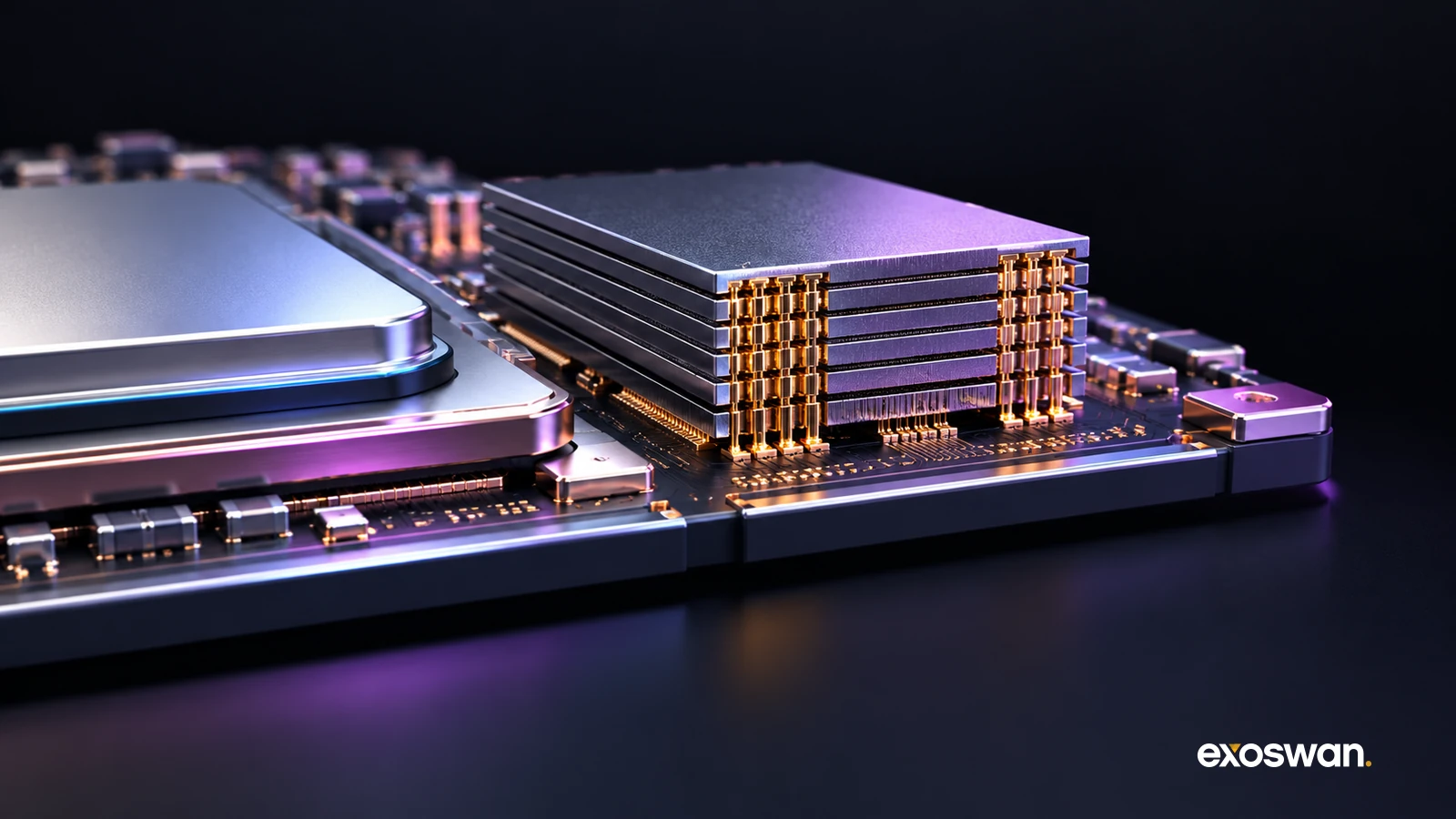
All of it traces back to one part. High bandwidth memory, or HBM, is ordinary DRAM stacked 8 to 16 chips high, wired together with thousands of vertical connections, and set right next to an AI processor so it can feed it data fast enough. An AI chip is only as quick as its memory, so every new Nvidia generation carries more HBM. Only three companies make it at scale: SK hynix, Samsung, and Micron. And because HBM eats so much factory space, it has squeezed ordinary memory too, sending regular DRAM contract prices up more than 90% in a single quarter this year.
So here's the argument over high bandwidth memory stocks for 2027. The makers say long-term contracts have turned memory from a commodity into something closer to a utility, and Micron says most of its 2027 HBM supply is already sold at much higher prices. The market, which has been burned by every memory cycle in history, is selling anyway.
These high bandwidth memory stocks are all in that fight: the three makers, the new supply that could end the cycle, the toolmakers that build every stack, and the foundry that's quietly moving into the stack itself.
Companies at a glance
10 companies| Company | Ticker | Segment | Thesis |
|---|---|---|---|
| SK hynix | KRX: 000660 / NASDAQ: SKHY | The makers | The purest HBM bet, which hurt in 2026 and should help in 2027 |
| Samsung Electronics | KRX: 005930 | The makers | The only maker with memory, logic and packaging under one roof |
| Micron | NASDAQ: MU | The makers | Arguing hardest that memory is now a contract business |
| CXMT | SSE: 688825 | New supply | China's DRAM champion is how this cycle could end |
| Hanmi Semiconductor | KRX: 042700 | The tools | Its bonders stack the chips, and it's paid when capacity grows |
| ASMPT | HKEX: 0522 | The tools | Taking bonder share at the biggest HBM maker |
| Disco | TSE: 6146 | The tools | Every chip in the stack has to be ground paper-thin first |
| BE Semiconductor | EURONEXT: BESI | The tools | Hybrid bonding is the next stacking method, and everyone wants it |
| Advantest | TSE: 6857 | The tools | Every stack has to be tested before it ships |
| TSMC | NYSE: TSM | The base die | Custom HBM moves part of the stack onto TSMC's wafers |
The Makers
Three companies make nearly all the world's HBM, and they don't agree on much except that the cycle is over.
SK hynix KRX: 000660 / NASDAQ: SKHY
SK hynix is the HBM leader, with about half the market in the second quarter, and the purest bet on it. That cut both ways this year. HBM is priced on annual contracts, so when ordinary DRAM prices exploded, SK hynix's heavy HBM mix couldn't catch the rise. Its DRAM revenue grew 38% last quarter while Samsung's and Micron's grew more than 60%.
2027 flips that. Its 2027 HBM contracts are being negotiated now, at prices that reflect this year's shortage, and it began mass shipments of the next generation, HBM4, in the second quarter. It's also handing a lot of cash back, with a ₩40 trillion buyback and a pledge to return more than half its free cash flow. In July it listed shares in New York, raising $26.5 billion.
Samsung Electronics KRX: 005930
Samsung Electronics spent two years as the HBM laggard. This year it came back. It says it shipped the industry's first commercial HBM4 in February, its share of the HBM market climbed to about a third by the second quarter, and it remains the world's biggest DRAM maker overall.
The reason to own it for HBM is structural. Each HBM stack sits on a base die, a logic chip at the bottom of the stack. SK hynix and Micron are turning to TSMC for theirs. Samsung makes its own in its foundry. As customers start asking for custom features built into that base die, being the only supplier that can design, make and stack everything in-house is a real advantage.
Micron NASDAQ: MU
Micron is making the loudest case that memory has changed for good. It says it has contracts covering the "vast majority" of its 2027 HBM supply at prices significantly higher than this year's. It has signed 26 strategic agreements with customers that cover more than a third of its revenue through 2030, backed by $32 billion of commitments.
It also exited its consumer memory business last year to put every wafer into data center products. Micron's HBM share slipped to about 18% in the second quarter, so it isn't winning on volume. It's betting on contracts. If those agreements hold through the next downturn, Micron will have proved the cycle is dead. If they get renegotiated, nothing has changed.
New Supply
Memory cycles end the same way every time: somebody builds too much.
CXMT SSE: 688825
CXMT, short for ChangXin Memory Technologies, is China's biggest DRAM maker and the fourth largest in the world. It listed in Shanghai in July and raised about ¥58 billion, roughly $8 billion.
Its HBM work is early and aimed at Chinese customers. That isn't the point. Every wafer CXMT makes of ordinary DRAM is supply the big three don't control, at a moment when they've moved a lot of their own capacity to HBM. If ordinary DRAM prices turn, CXMT is the most likely reason. Owning it is a hedge against everything else on this list.
The Tools
Building an HBM stack takes specialized equipment at every step. These companies get paid when the makers add capacity, whatever happens to memory prices later. That makes them the high bandwidth memory stocks least tied to the cycle.
Hanmi Semiconductor KRX: 042700
Hanmi Semiconductor makes thermal compression bonders, the machines that press each layer of an HBM stack together. It has long been SK hynix's main bonder supplier, which placed a ₩44 billion order for HBM4 bonders in June.
Second-quarter revenue was ₩251 billion with an operating margin above 50%. It's as direct a bet on HBM capacity as you can buy.
ASMPT HKEX: 0522
ASMPT is the challenger to Hanmi. Reports late last year said it won roughly half of SK hynix's HBM4 bonder orders, a big crack in what had been Hanmi's account.
First-half bookings jumped 85% to $1.63 billion. ASMPT is a broad packaging-equipment company, so HBM is one engine of several. But winning share at the biggest HBM maker gives it a foothold for every generation after this one.
Disco TSE: 6146
To stack 12 or 16 memory chips into a package the height of a single chip, each one has to be ground thinner than a sheet of paper and cut cleanly. Disco makes the grinders and saws that do it, and it dominates that market.
Its last quarter brought record shipments, driven by HBM and advanced logic chips, with operating income up 42%. Taller stacks mean thinner chips and more grinding, which is exactly where HBM is heading.
BE Semiconductor EURONEXT: BESI
BE Semiconductor, or Besi, leads in hybrid bonding, which fuses chips together directly, with no tiny solder bumps in between. As HBM stacks get taller, the industry expects to need it, because there's no room left for bumps.
It isn't in HBM yet. Besi doesn't report memory revenue, and the timing depends on when the makers switch. But its hybrid-bonding customer count rose from 15 to 21 this year, Applied Materials owns 9% of it, and Reuters reported in March that Lam Research had held takeover talks. When the biggest toolmakers circle a company, they're telling you what they think the next stacking method is.
Advantest TSE: 6857
Every HBM stack has to be tested before it ships, because one bad chip ruins the whole stack and the expensive AI processor next to it. Advantest is the biggest maker of testers for advanced chips.
Most of its business is testing logic chips like GPUs, but its memory tester sales are growing, led by high-performance DRAM. Operating income rose 53% last quarter.
The Base Die
TSMC NYSE: TSM
TSMC doesn't make memory. It's here because it's moving into the memory stack.
SK hynix uses TSMC to make the base die for its HBM4, and Micron will use TSMC for its next-generation HBM4E. As the base die takes on more custom logic, more of each HBM stack's value lands on a TSMC wafer, whoever's name is on the memory.
The Future of High Bandwidth Memory
Long-term contracts won't end the memory cycle. Custom memory might.
Contracts have been tried before. When prices crash, buyers find a way to renegotiate, and suppliers usually let them rather than lose the customer. What's new is that starting with HBM4E, customers can order a base die with their own logic built in. Micron has said that once memory is custom, customers may use only one or two suppliers per project.
That changes what memory is. A custom HBM stack can't be swapped for a competitor's off the shelf, any more than you could swap one company's AI chip for another's. It gets designed in, qualified, and locked for the life of the product.
If custom HBM takes off, memory starts behaving like logic: fewer, bigger, stickier customers, and prices set by design wins, not by spot markets. That would be the real end of the cycle. For high bandwidth memory stocks, the contracts the makers are touting today are just the bridge to get there.