
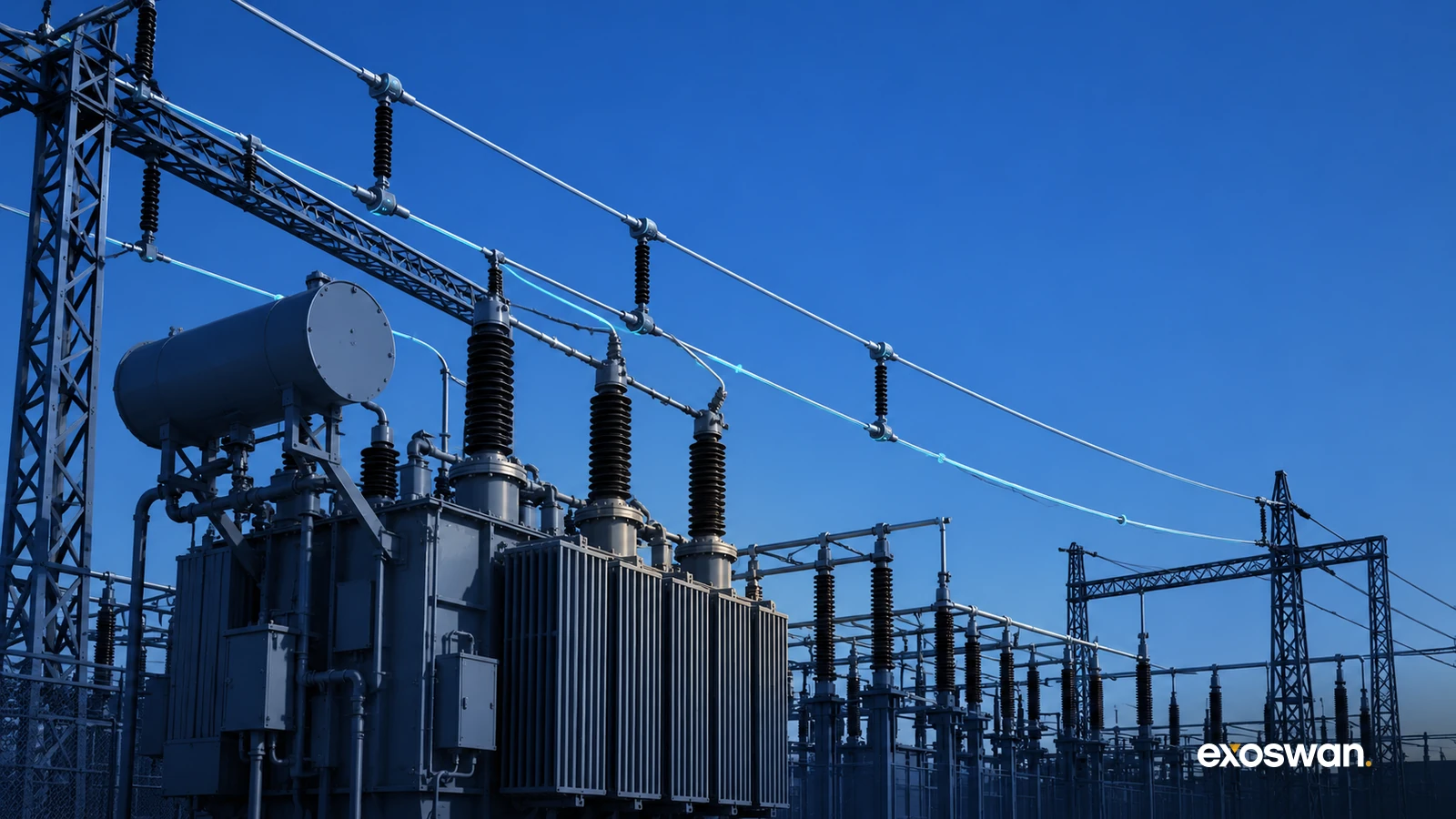
The Setup: Grid Modernization Stocks
America has mostly stopped building new grid. It patches the old one instead, and the patch job has become one of the best businesses in power.
The new-build side is grim. The U.S. finished 322 miles of high-voltage transmission line in 2024, against a need that industry groups put closer to 5,000 miles a year, and a new long-distance line still takes a decade of permits, lawsuits, and fights over who pays.
Everything else is booming, because the power grid is a lot more than long-distance lines. It's everything between a power plant and your outlet: substations full of transformers and switchgear that step voltage down, plus the distribution lines, meters, and control software that carry power the last mile. For decades, demand on all of it was flat. Now data centers, factories, and electrification are asking for more at once, and since new corridors won't arrive in time, the money goes into substations, equipment, and upgrades to lines that already exist. As of mid-2025, the wait for a large power transformer was about two and a half years.
The market has priced that into grid modernization stocks. Quanta Services, which builds much of the grid, trades at about 37 times next year's earnings. And the shortage isn't easing. PJM, the biggest grid operator in the U.S., just ran a capacity auction that cleared at its price cap for the third straight time and still came up short.
The grid modernization stocks below are grouped by which part of the patch job each company owns: the transformer makers, the hookup to big customers, the crews, the cable, and the companies squeezing more out of the lines already standing.
Companies at a glance
11 companies| Company | Ticker | Segment | Thesis |
|---|---|---|---|
| GE Vernova | NYSE: GEV | The boxes | Paid $5 billion to own transformer capacity in the middle of a shortage |
| Siemens Energy | ETR: ENR | The boxes | A €51 billion grid backlog lets it pick the orders it wants |
| Hitachi | TSE: 6501 | The boxes | Building the transformer plants everyone else is waiting on |
| HD Hyundai Electric | KRX: 267260 | The boxes | Korean imports are how the U.S. fills its transformer gap |
| Eaton | NYSE: ETN | The hookup | Sells the gear between the utility and the data center |
| Powell Industries | NASDAQ: POWL | The hookup | Custom electrical rooms for the biggest new loads |
| Quanta Services | NYSE: PWR | The crews | The labor to install it all, which is scarcer than the equipment |
| Prysmian | BIT: PRY | The cable | Spending its transmission windfall on the part of the grid that's actually growing |
| Hubbell | NYSE: HUBB | The squeeze | Sells the thousands of small parts utilities replace every year |
| AMSC | NASDAQ: AMSC | The squeeze | Power electronics that push more through the wires already there |
| Itron | NASDAQ: ITRI | The squeeze | The data layer that shows utilities where the slack is |
The Boxes
A large power transformer is the one piece of the grid you can't design around, and there still aren't enough of them. That shortage is what's driving these four grid modernization stocks.
GE Vernova NYSE: GEV
GE Vernova paid about $5.25 billion in February for the half of Prolec GE it didn't already own. Prolec makes transformers. In a shortage, that's buying the bottleneck.
It's working so far. GE Vernova's electrification business booked $6.3 billion of orders last quarter, up 66% on an organic basis, and its equipment backlog there reached $40.6 billion. Data centers alone have ordered more than $5 billion of grid equipment from it this year, more than double all of 2025.
Siemens Energy ETR: ENR
Siemens Energy has a €51 billion backlog in its grid business. Orders there grew 28% last quarter and came in about one and a half times revenue, led by transformers.
A backlog that size changes the business. When you're booked out for years, you get to choose which orders to take, and you take the ones with better prices and better terms. That's why its grid margin is now close to 20%, a level a utility-equipment business rarely sees.
Hitachi TSE: 6501
Hitachi Energy, the old ABB grid business that Hitachi bought in 2020, is spending its way through the shortage. It's in the middle of a $9 billion global expansion. In the U.S. alone, that includes a large power transformer plant in South Boston, Virginia, and a $528 million plant in Mississippi, announced in September, that will replace an existing factory with one more than twice the capacity when production starts in 2029.
Those plants take years. Hitachi is betting that when they open, it will be the supplier with transformers to sell while others are still catching up.
HD Hyundai Electric KRX: 267260
The U.S. doesn't make enough transformers, so it imports them, and South Korean makers are among the biggest suppliers. HD Hyundai Electric is the clearest way to own that trade.
Its orders grew 45% last quarter, its backlog is $8.5 billion, and it earned an operating margin of about 25%. Those are shortage numbers. The Korean power-equipment group has started to cool off, with analysts trimming valuation targets after a rival missed estimates in August. The order book is still growing.
The Hookup
Where the grid meets a big customer, the work moves faster, because the customer is paying for speed.
Eaton NYSE: ETN
Eaton makes the switchgear, breakers and power distribution gear that sit between the utility's line and whatever is drawing power. Increasingly, that's a data center.
Its Americas electrical business grew 18% organically last quarter, with orders up 41% over the past year and backlog up a third. In March it closed a $9.5 billion purchase of Boyd Thermal, a liquid-cooling business, which tells you exactly who Eaton thinks its best customer is.
Powell Industries NASDAQ: POWL
Powell Industries builds custom switchgear and electrical rooms for very large power users: refineries, utilities, LNG plants, and now data centers. It's a small Houston company that has been quietly doing this for decades.
Its backlog stood at $2.4 billion in June, roughly two years of revenue. When a giant new load needs to hook into the grid, someone has to build the room where the power arrives. Powell is one of the few that can do it at that scale.
The Crews
Equipment can be ordered. People to install it take years to train.
Quanta Services NYSE: PWR
Quanta Services is the biggest specialty contractor for utilities in North America. It strings the wire, builds the substations, and connects the new loads.
Its backlog climbed to $53.4 billion at the end of June, up from $44 billion at the start of the year, and second-quarter revenue rose more than 40%. The scarce input in grid work isn't money or steel. It's trained line workers, and Quanta has spent decades building one of the deepest benches of them. That's the moat, and the valuation already knows it.
The Cable
Cable makers sold out their high-voltage lines years ahead. The question is what they do with the cash.
Prysmian BIT: PRY
Prysmian is the world's biggest cable maker, and its high-voltage transmission business is a gold mine right now: margins above 21% and about €17 billion of backlog. But transmission cable projects are lumpy, and Europe's other big cable makers saw that business slow in the second quarter.
So Prysmian is moving its windfall toward the patch job. In August it agreed to buy Atkore, a U.S. maker of electrical conduit and cable, for $95 a share, about $3.8 billion including debt. Atkore's products go into the buildings, data centers and distribution networks that are actually getting built. The deal is expected to close by year-end.
The Squeeze
If you can't build new lines, you get more out of the old ones, and these three companies sell the tools to do it.
Hubbell NYSE: HUBB
Hubbell sells the unglamorous bits utilities buy by the truckload: connectors, insulators, surge arresters, anchors. Patching the grid is its whole business.
That makes it the steadiest name on this list. Its utility business did about $1 billion of sales last quarter, up 10%, and it doesn't depend on a single giant transmission project getting approved. It depends on utilities replacing old parts, which they do every year.
AMSC NASDAQ: AMSC
AMSC makes power-electronics systems that stabilize voltage on the grid, which lets operators push more power through lines they already own. It's the cheapest way to add capacity when a new line is ten years away.
Revenue hit a record $94 million last quarter, up 30%, with the grid business making up 81% of it, and orders topped $130 million. The stock has still roughly halved over the past year. This is a small, lumpy, project-driven company, and that's both the risk and the upside.
Itron NASDAQ: ITRI
Itron makes smart meters, the networks that connect them, and the software that tells a utility what's actually happening on its system. You can't squeeze slack out of a grid you can't see.
Hardware revenue is lumpy, and total revenue fell 7% last quarter. Recurring software revenue grew 21%, and Itron spent about $550 million this year on Locusview, which helps utilities manage field construction. The market has marked it down to around 13 times forward earnings, a fraction of what the equipment makers fetch. It's pricing Itron like a meter vendor rather than the grid's data layer.
The Future of Grid Modernization
The grid is about to run at two speeds.
Utilities build at the speed of regulators. Every dollar they spend has to be approved, and someone's power bill pays it back. PJM's capacity auctions show what happens when big new loads pile onto that system: prices hit the cap, the shortfall stays, and households get the bill. The political pressure is pushing toward one answer: make the data centers pay for their own connections.
They already are. GE Vernova's data center grid orders this year are more than double all of last year's. Eaton just bought a cooling company. Hyperscalers are ordering substations and transformers directly, because waiting for a rate case costs them more than the equipment does.
Equipment sold to utilities will keep moving at the regulator's pace and price. Equipment sold to data centers moves at tech-company speed, at tech-company prices. In 2027, the grid modernization stocks to own are the companies whose orders come from the second group.