
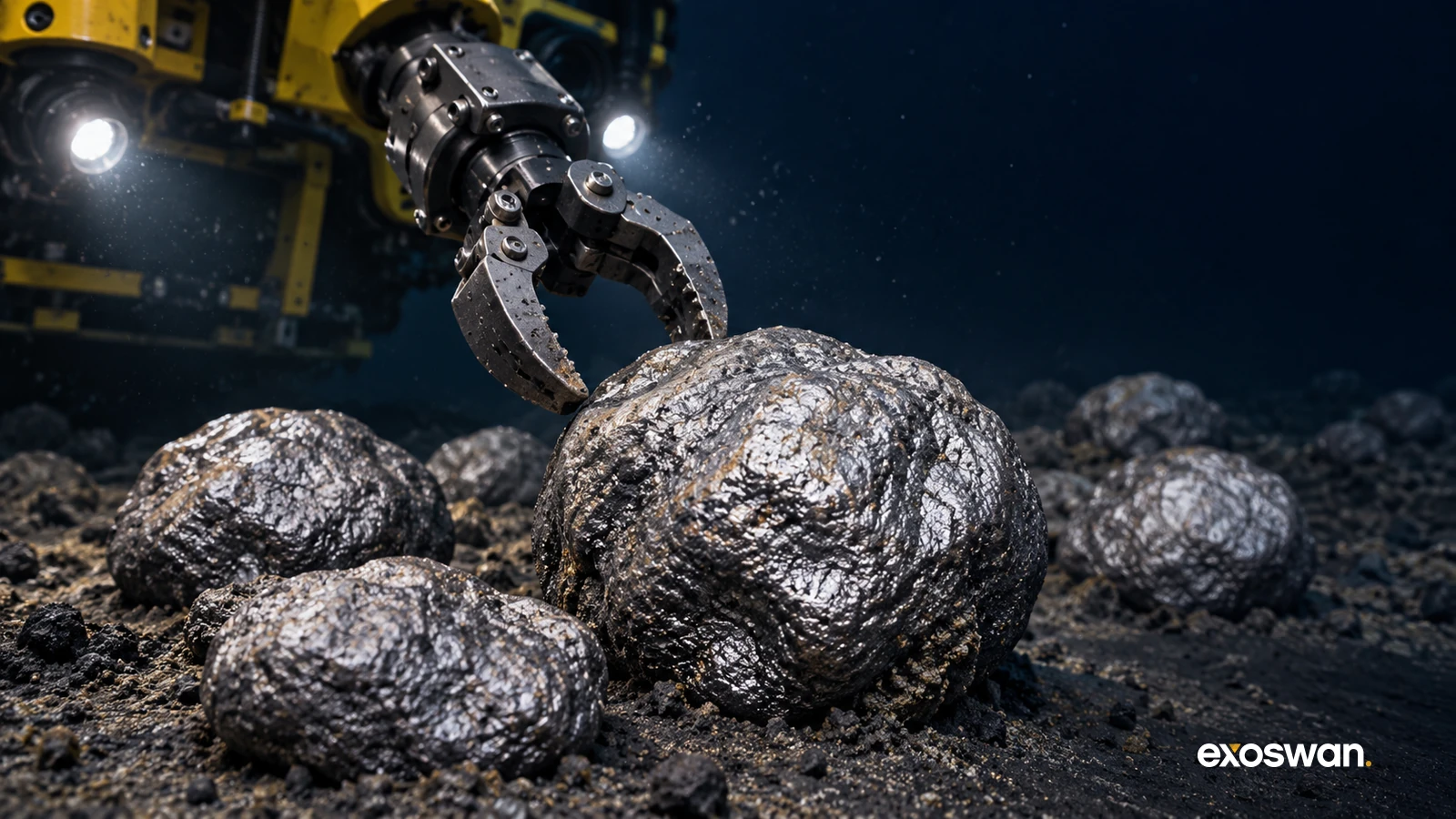
The Setup: Deep Sea Mining Stocks
Deep sea mining technology is still pre-commercial. NOAA says no commercial-scale deep sea mining has occurred globally, but the U.S. has moved from talking about seabed minerals to building an actual permitting lane.
President Trump’s April 2025 executive order pushed agencies to accelerate exploration, recovery, processing, and financing. In January 2026, NOAA created a consolidated process that lets qualified applicants pursue an exploration license and commercial recovery permit together. By August, NOAA had multiple applications in review and had published The Metals Company’s first consolidated commercial-recovery application for public comment.
The international track is moving much slower. The International Seabed Authority spent July 2026 negotiating its exploitation rules but did not finish the Mining Code; formal intersessional work now runs into the March 2027 Council session. So the sector has split into two lanes: a faster, U.S.-driven NOAA pathway and a slower multilateral ISA pathway.
The bull case is simple: critical-mineral security turns polymetallic nodules and seafloor sulfides into strategic assets, regulators issue workable permits, and deep-ocean collection systems graduate from pilot hardware to boring, repeatable industrial equipment. The bear case is equally simple: courts, politics, environmental opposition, or ugly unit economics stop the industry before “resource” becomes “revenue.”
We’re slicing deep sea mining stocks into frontier pure-plays, royalty exposure, industrial optionality, and private bellwethers.
| Company | Ticker | Segment | Thesis |
|---|---|---|---|
| TMC the metals company | NASDAQ: TMC | Pure-play | Most advanced listed nodule developer; NOAA commercial-permit process plus Allseas production system |
| Odyssey Marine Exploration / American Ocean Minerals | NASDAQ: OMEX → AOMC (pending) | Merger vehicle | Pending combination creates a U.S./Cook Islands nodule platform with fresh financing |
| Deep Sea Minerals Corp. | CSE: SEAS / OTCQB: DSEAF | Pure-play | Microcap NOAA applicant; Impossible Metals robotics MOU; very early-stage |
| Green Minerals AS | Euronext Growth Oslo: GEM | Pure-play | Norway-focused seafloor copper optionality, but licensing is politically delayed |
| The Metals Royalty Company | NASDAQ: TMCR | Royalty | 2.0% gross overriding royalty on TMC’s NORI area; direct economics without operating the mine |
| DEME Group | Euronext Brussels: DEME | Industrial | Profitable offshore contractor with GSR deep-sea mineral subsidiary and Japan demo work |
| Allseas | Private | Private | TMC’s commercial collection-system partner; owns and operates Hidden Gem |
| Impossible Metals | Private | Private | Autonomous, selective nodule-collection robotics; alternative to giant riser systems |
| Eco Minerals | Private | Private | U.S. NOAA applicant developing its own recovery concept; positioning for eventual public-market access |
Frontier Pure-Plays
This is where the theme is concentrated, and where the risk is concentrated too. These companies live or die on permits, financing, resource quality, collection hardware, processing, and metal prices. There is very little “normal business” underneath them to catch the stock if the theme slips.
TMC the metals companyNASDAQ: TMC
TMC the metals company is the flagship public deep-sea mining stock because it’s furthest along on three things that actually matter: resource definition, collection hardware, and a commercial permitting process.
Its TMC USA-A consolidated application covers roughly 65,000 square kilometers of the Clarion-Clipperton Zone and an estimated 619 million wet tonnes of polymetallic nodules, with additional exploration upside claimed by the company. NOAA published the application in the Federal Register in August 2026, opening a public comment period through October 19 and scheduling a virtual public hearing for October 13. Separately, NOAA has already certified TMC USA-B and started the environmental-review process for that exploration area.
The permitting question has become immediate: regulators are looking at it now.
TMC also has the hardware partner most competitors wish they had. In May, it signed a commercial agreement with Allseas to finish and operate a system designed for 3.0 million wet tonnes of nodules per year. The system uses the Hidden Gem production vessel, two collector vehicles, a riser, and support vessels. Commissioning is targeted for Q4 2027, subject to permits.
Financially, TMC ended June with about $98.7 million of cash and roughly $143 million of available liquidity including credit facilities. That’s meaningful runway for a pre-revenue miner, but it’s not a magic shield. Offshore systems, environmental work, processing, and commercialization can eat capital very quickly.
The next stretch turns on NOAA’s certification and EIS process for USA-A, the October public-comment cycle, U.S. government funding or offtake support, Allseas procurement milestones, and any change to the company’s Q4 2027 commissioning target. The legal flank matters too: TMC’s move toward the U.S. regime sits alongside unresolved ISA-related disputes involving its subsidiaries.
Odyssey Marine Exploration / American Ocean Minerals (NASDAQ: OMEX; AOMC pending)
Odyssey Marine Exploration is currently less a standalone deep-sea mining stock than a merger wrapper.
In April 2026, Odyssey agreed to combine with American Ocean Minerals. If the transaction closes, the combined company is expected to operate as American Ocean Minerals Corporation and trade under AOMC. The pitch is scale: U.S. application-stage areas, interests tied to two Cook Islands nodule exploration license holders, Odyssey’s marine-operations experience, and a financing package that included a $156 million PIPE plus roughly $75 million of pre-public financing at AOM.
That makes OMEX interesting, but messy.
The merger still hadn’t closed as of Odyssey’s August 2026 quarterly filing. OMEX also received a Nasdaq minimum-bid-price deficiency notice in July and has shareholder approval for a reverse split in the 1-for-20 to 1-for-25 range. Management expects the reverse split to help restore compliance before the merger becomes effective.
So there are two trades stapled together here: “deep-sea minerals become real” and “this merger/capital structure executes cleanly.” Retail investors should not confuse the first with the second.
For OMEX, the next milestones are S-4 effectiveness, the shareholder vote and merger close, final exchange/ticker mechanics, reverse-split timing, and whether AOM’s U.S. and Cook Islands programs hit technical and regulatory milestones after the corporate combination.
Deep Sea Minerals Corp. (CSE: SEAS / OTCQB: DSEAF)
Deep Sea Minerals Corp. is what an early frontier-tech stock looks like before the frontier becomes an industry.
The company rebranded from Copperhead Resources in January 2026 and pivoted toward deep-sea mineral rights. Its U.S. subsidiary submitted a NOAA exploration-license application for a Clarion-Clipperton Zone area. NOAA determined the application was in substantial compliance in May; the company submitted an amended application on July 17 to address NOAA’s request for more detail on financing, technical plans, environmental work, and ocean-use conflicts.
That’s real progress, and it’s still very early.
SEAS doesn’t yet have a deep-sea exploration license, much less a commercial permit or production system. In July it signed an MOU with Impossible Metals to evaluate autonomous, riserless nodule-collection technology if licenses are awarded. The company raised about C$4.2 million in a February private placement and had roughly C$2.9 million of cash at the end of March; it has since filed a C$50 million shelf prospectus, which gives it financing flexibility and creates obvious dilution risk.
This stock belongs on a watchlist because a favorable NOAA decision could materially change the story. It doesn’t belong in the same maturity bucket as TMC.
Near-term, NOAA’s full-compliance decision matters most, followed by proof that the company can fund environmental and offshore work, conversion of the Impossible Metals MOU into a concrete program, and any large equity issuance under the shelf.
Green Minerals AS (Euronext Growth Oslo: GEM)
Green Minerals is the weird one, and that’s exactly why it’s useful to watch.
Unlike the CCZ nodule names, Green Minerals is primarily targeting copper-rich seafloor massive sulfide / volcanogenic massive sulfide systems on the Norwegian continental shelf. The resource concept is attractive: high-grade offshore copper with less fixed mine infrastructure than a traditional land-based project.
Politics is the choke point.
Norway opened areas for seabed minerals in 2024, then hit the brakes. The government later stated that it would not announce the first seabed-mineral licensing round during the current parliamentary term. Green Minerals’ August 2026 presentation still lists the license award as TBA and says its strategic review is continuing.
The balance sheet makes the delay matter. At June 30, Green Minerals reported no revenue, about NOK 3.1 million in cash, and roughly NOK 2.3 million of Bitcoin holdings. Its Bitcoin treasury strategy adds another variable to a stock that already has more than enough variables.
GEM is a long-dated Norway seabed-minerals option with financing risk, policy risk, and a side helping of crypto exposure. If Norway restarts licensing, the stock can get interesting fast. Until then, time is the enemy.
Watch for any Norwegian policy reversal or licensing roadmap, the outcome of the strategic review, cash runway, equity financing, and whether management shifts capital toward jurisdictions with a faster regulatory path.
Royalty Exposure
A royalty company is a different bet from an operator. It doesn’t need to build the collector, run the vessel, or process the nodules; it needs the underlying project to get permitted and produce enough metal for the royalty to matter.
The Metals Royalty CompanyNASDAQ: TMCR
The Metals Royalty Company is the cleanest public way to get economic exposure to TMC’s NORI area without owning the operator itself.
TMCR began trading on Nasdaq in April 2026 and owns a 2.0% gross overriding royalty on TMC’s NORI area. TMC also retained a meaningful equity stake in the royalty company after subsequent financing, so the two stories are still closely linked.
That setup changes the risk mix. TMCR avoids the direct burden of funding collectors, vessels, environmental work, and mine development, but it still depends on TMC getting permitted, reaching commercial production, and generating enough value from NORI for the royalty to become material.
The stock belongs on the watchlist because the public deep-sea universe is so thin. If TMC advances, TMCR gives investors another way to express the same core thesis with different capital intensity and different dilution risk.
Watch TMC’s USA-A permitting milestones, any changes to TMCR’s royalty portfolio, financing activity, and the size of TMC’s continuing ownership stake.
Industrial Optionality
These stocks don’t live or die on deep-sea mining. That lowers the torque to a sector breakthrough, but it also means the company can survive if regulators spend another five years arguing in conference rooms.
DEME Group (Euronext Brussels: DEME)
DEME Group is the grown-up in this watchlist.
The Belgian marine-engineering group makes its money from offshore energy, dredging, infrastructure, and environmental work. Deep-sea minerals sit inside its concessions portfolio through Global Sea Mineral Resources (GSR). In March 2026, GSR signed an MOU with Japan’s Deep Ocean Resources Development Co. to support a joint demonstration test of an integrated commercial-scale nodule-mining system in the Clarion-Clipperton Zone.
DEME already knows how to run complicated offshore assets. It isn’t trying to invent project execution from scratch.
The trade-off is obvious: GSR is only a piece of a much larger company. DEME generated €2.2 billion of first-half 2026 revenue, €466 million of EBITDA, and €215 million of net profit. If deep-sea mining works, GSR can become a valuable technology/concession option. If it fails, DEME still has a real business.
For a retail investor who wants exposure without betting the portfolio on one permit, DEME is the lower-octane name. The stock will never move like a microcap pure-play on a NOAA headline. That’s the point.
Watch the timing and details of the GSR/DORD demonstration, any new strategic partners, GSR’s role in DEME’s capital allocation, and whether deep-sea harvesting starts showing up as more than a research/concession line item.
Private Bellwethers
The public stocks get the ticker attention. The private hardware companies may decide who can actually produce anything.
Allseas (Private)
Allseas is the company turning TMC’s resource story into a ship-and-machinery story.
Its Hidden Gem vessel completed an integrated nodule-collection pilot in 2022, recovering about 3,000 tonnes of nodules from more than four kilometers deep. The 2026 commercial agreement with TMC puts Allseas in charge of completing, commissioning, and operating a 3.0-million-tonne-per-year production system.
That makes Allseas a bellwether for the whole industry. Watch its engineering progress more closely than the glossy resource maps. If the riser, collectors, launch-and-recovery gear, logistics chain, and vessel uptime work at commercial scale, deep-sea mining starts looking like an offshore-services industry. If they don’t, the nodules can stay exactly where they are.
Allseas remains private. No credible IPO timetable has been announced.
Impossible Metals (Private)
Impossible Metals is betting that the first generation of deep-sea mining hardware is too blunt.
Instead of vacuuming or scooping broad sections of seabed into a giant riser system, its concept uses autonomous underwater robots with computer vision and robotic arms to selectively collect individual nodules. The selling point is lower disturbance and a system that can scale by adding robots instead of building one monster offshore machine.
In August 2026, the company said its Eureka II vehicle completed an autonomous self-recovery demonstration. It also has the July MOU with Deep Sea Minerals Corp. to evaluate deployment in future licensed areas.
This is the technology wild card. Selective robotics could reduce environmental impact and regulatory friction. Or it could turn out to be too slow and expensive per tonne. Either outcome would tell investors something important about which collection architecture wins.
Impossible Metals remains private, with no public IPO timetable disclosed.
Eco Minerals (Private)
Eco Minerals is another U.S.-pathway bellwether, and one worth watching because it is trying to pair mineral access with its own recovery-system concept.
Formerly known as Deep Sea Rare Minerals, the company says NOAA has found its exploration application fully compliant. That moves it beyond the earliest paperwork stage, but it is still a long way from commercial production.
The company has also been developing its own recovery approach rather than simply waiting for a third-party collection architecture to win. That makes it useful as a read on whether smaller entrants can build differentiated technology stacks instead of copying the first-generation TMC/Allseas model.
There is also a capital-markets angle. Eco Minerals framed its May 2026 rebrand as part of positioning the company for a future move toward public markets, though it has not announced an IPO timetable.
Watch NOAA milestones, evidence that the recovery concept works at meaningful scale, financing, and any concrete step toward a public listing.
How Deep Sea Mining Stocks Fail
The first failure mode is permission.
NOAA can move quickly and still say no, attach restrictive conditions, or spend years in environmental review and litigation. The ISA still hasn’t finished its Mining Code, and its August 2026–March 2027 work program shows how many issues remain open. A change in U.S. political priorities would hit the current pure-plays especially hard because 2026 valuations increasingly assume the U.S. pathway is real.
The second failure mode is physics plus economics.
No one has run commercial-scale deep-sea nodule production for years on end. Sediment plumes, benthic habitat loss, noise, equipment reliability, four-kilometer water depth, transfer at sea, processing recoveries, and metal-price swings all stack on top of one another. Environmental concerns shape permitting and operating constraints, and they can change the entire cost structure.
The specific signals to watch are brutally practical: permit terms, collector uptime, tonnes recovered per operating day, cost per wet tonne, processing yields, capex escalation, and whether buyers or governments sign bankable offtake agreements.
The Future of Deep Sea Mining
The next 12–18 months should answer whether 2026 was the start of an industry or just the start of a much louder argument.
The biggest near-term catalyst is TMC USA-A. NOAA’s public-comment period runs through October 19, 2026, with a hearing on October 13. After that come certification, environmental review, draft terms and conditions, and a final permit decision. TMC has said it expects a permit before the end of Q1 2027, but NOAA’s process has no guaranteed finish line.
Then comes hardware. TMC and Allseas are targeting Q4 2027 for commissioning of the first 3.0-million-tonne-per-year system. That’s the sector’s most important engineering milestone because it forces the debate out of PowerPoint and into uptime, throughput, maintenance, and dollars per tonne.
At the smaller end, watch Deep Sea Minerals’ NOAA review and the Odyssey/American Ocean Minerals merger. Either could create another credible U.S.-market competitor. Green Minerals is the opposite case: the resource thesis can be fine while the jurisdiction makes the equity dead money.
And internationally, the ISA moves into another heavy negotiation cycle in 2027. If the Mining Code finally converges, the investable universe gets wider. If it keeps slipping while NOAA advances U.S.-sponsored projects, the market will increasingly value companies by jurisdiction first, resource second.
The deep sea has plenty of metal; the scarce resource is a permit that survives contact with politics, courts, environmental science, and a 4,000-meter operating environment.