
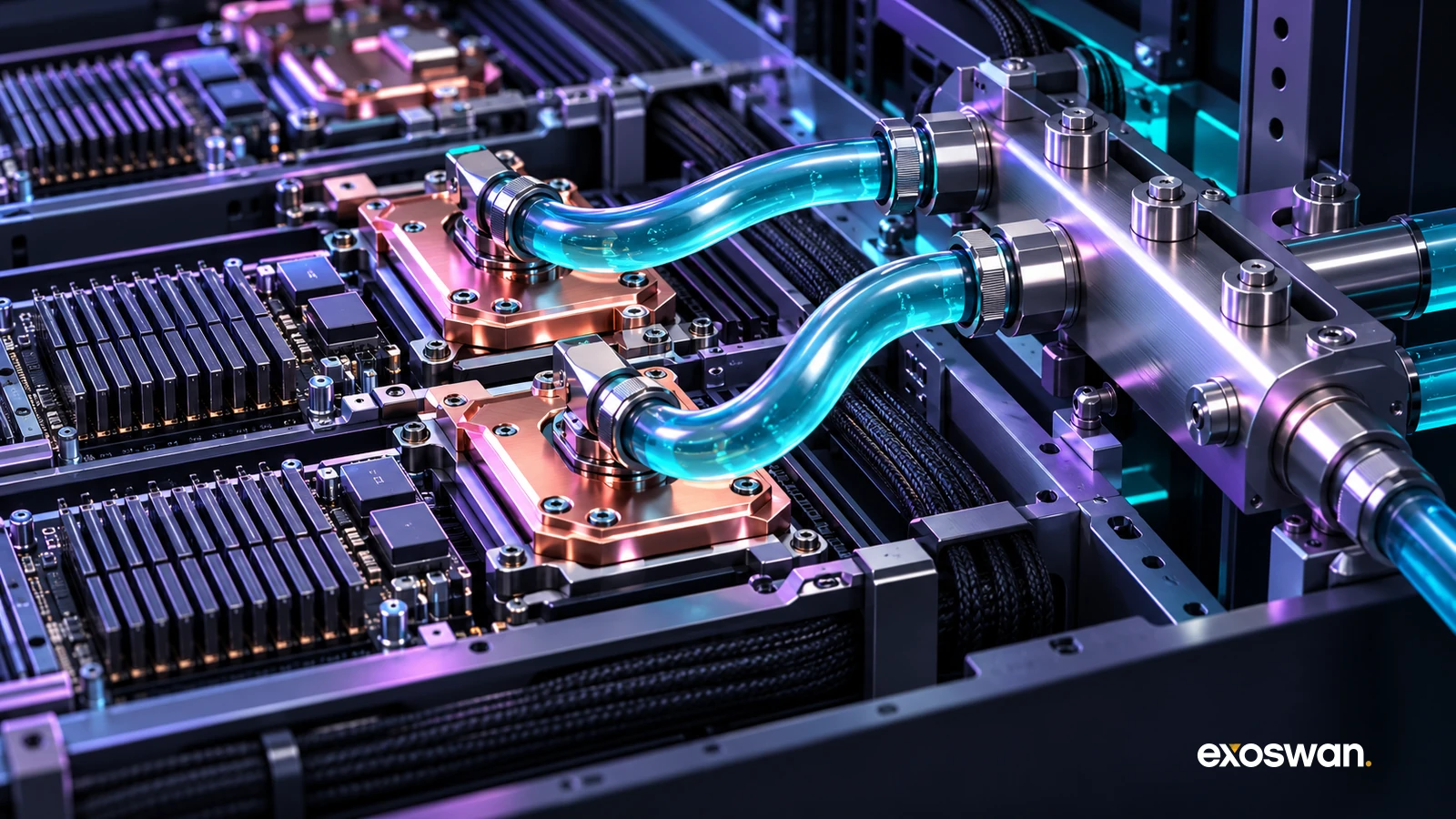
The Setup: Data Center Cooling Stocks
AI chips have a heat problem.
That sounds almost comically simple. But once a rack starts gulping tens, and increasingly hundreds, of kilowatts, “just add more fans” stops being an engineering plan. The bottleneck moves from the GPU to everything wrapped around it: cold plates, coolant distribution units (CDUs),[1] pumps, manifolds, chillers, heat exchangers, dry coolers, controls, and the service teams that keep the whole thermal loop alive.
That’s why data center cooling has gone from sleepy HVAC niche to frontier-tech infrastructure theme.
The demand backdrop is real. The IEA estimates global data center electricity consumption at roughly 415 TWh in 2024 and projects about 945 TWh by 2030. Cooling alone can consume roughly 7% of electricity in efficient hyperscale facilities and more than 30% in less-efficient enterprise sites. Meanwhile, Uptime Institute's 2026 survey says more operators are reporting peak rack densities of 30 kW or higher, while its research points to AI hardware roadmaps pushing rack power beyond 200 kW.
The bigger tell is what industrial companies are willing to pay for cooling assets. Eaton closed its $9.5 billion purchase of Boyd Thermal in March 2026. Ecolab closed its $4.75 billion purchase of CoolIT in July. Trane bought LiquidStack. Schneider Electric folded Motivair into its data center stack. Vertiv has been acquiring cold-plate know-how and heat-rejection capacity.
We’re slicing data center cooling stocks it into Cooling Leaders, companies where data center thermal management is a major growth engine; Integrated Platforms, which are buying or building end-to-end cooling stacks; and Private Bellwethers, which show where the next technology jump may come from.
| Company | Ticker | Segment | Thesis |
|---|---|---|---|
| Vertiv | NYSE: VRT | Cooling Leader | Full thermal chain; liquid cooling, chillers, heat rejection, controls |
| Modine | NYSE: MOD | Cooling Leader | Airedale hyperscale exposure; $4B capacity deal for 2027–2029 |
| Munters | STO: MTRS | Cooling Leader | AI-focused CDUs, CRAHs and chillers with large multi-year orders |
| AAON | NASDAQ: AAON | Cooling Leader | BASX data center cooling; liquid-cooling sales and backlog scaling fast |
| Ecolab | NYSE: ECL | Integrated Platform | Bought CoolIT for $4.75B; combines direct liquid cooling with water chemistry |
| Trane Technologies | NYSE: TT | Integrated Platform | LiquidStack adds direct-to-chip and immersion to a global chiller platform |
| Johnson Controls | NYSE: JCI | Integrated Platform | Silent-Aire CDUs plus YORK chillers; investing deeper into chip-level cooling |
| Eaton | NYSE: ETN | Integrated Platform | $9.5B Boyd Thermal deal creates a power-plus-cooling “grid to chip” stack |
| Schneider Electric | EPA: SU | Integrated Platform | Motivair gives Schneider CDUs, cold plates and chip-to-chiller liquid cooling |
| nVent Electric | NYSE: NVT | Integrated Platform | Rack- and row-level CDUs, manifolds, rear-door cooling and new capacity |
| Delta Electronics | TWSE: 2308 | Integrated Platform | 3 MW CDUs plus cold plates, power conversion and modular AI infrastructure |
| ZutaCore | Private | Private | Waterless two-phase direct-to-chip; $100M Series C in 2026 |
| Accelsius | Private | Private | Two-phase direct-to-chip; $65M Series B and early large-scale deployments |
Cooling Leaders
These are the names where cooling is not a cute adjacency buried on slide 47. It’s close to the center of the growth story. If AI rack density keeps climbing, these companies should see the demand signal early, and their execution problems early too.
VertivNYSE: VRT
Vertiv is the obvious heavyweight. It sells the unglamorous stuff an AI factory cannot run without: power distribution, UPS systems, thermal management, controls, prefabricated infrastructure and service. On cooling specifically, its portfolio now spans direct-to-chip systems, CDUs, immersion, rear-door heat exchangers, chillers and heat rejection.
The company spent 2026 filling gaps in that chain. It bought Strategic Thermal Labs for cold-plate and server-side liquid-cooling expertise, then completed the acquisition of ThermoKey to expand heat-rejection and heat-exchange capacity. It is also expanding cooling manufacturing in Italy and Ohio.
The financial momentum explains why investors care. Q2 2026 sales rose 24% year over year, and Vertiv raised full-year guidance to roughly 31% organic sales growth at the midpoint. The catch is obvious: this is no undiscovered penny stock. Expectations are already doing bench presses. For the watchlist, the key question is whether Vertiv can keep converting AI infrastructure demand into growth without margins getting chewed up by capacity expansion, supply constraints or a hyperscaler capex air pocket.
ModineNYSE: MOD
Modine is the higher-beta cooling story.
Its Airedale business sells chillers, fan walls and other critical cooling gear into hyperscale data centers. In the quarter ended June 2026, Modine's Data Centers segment posted $348.6 million of sales, up 90% from a year earlier. Then came the giant neon sign: a strategic customer signed a long-term capacity agreement covering more than $4 billion of Airedale cooling products for calendar 2027 through 2029, including a $165 million upfront payment to support capacity expansion.
That’s monster visibility. It’s also monster execution risk. Data Center gross margin dropped sharply in the latest quarter as Modine absorbed expansion costs, production inefficiencies, material pressure and supply-chain constraints. So the thesis is not “demand good.” We already know demand is good. The thesis is whether Modine can turn that demand into clean throughput and normalized margins as new capacity ramps.
MuntersSTO: MTRS
Munters is the less-hyped European cooling specialist worth knowing.
Its Data Center Technologies unit sells the plumbing around high-density compute: CDUs, CRAHs, fan walls, dry coolers and chillers. In April 2026, Munters won a roughly SEK 2.0 billion order for a modular AI cooling platform combining high-capacity CDUs with over-the-rack CRAHs, with deliveries expected from early 2027 through Q1 2028. That sits alongside a growing pile of large U.S. hyperscale and colocation orders.
Munters is interesting because it can participate whether the final architecture is air, liquid or hybrid. It doesn’t need one cooling religion to win. The numbers can get lumpy: giant project awards make headlines, but timing, customer concentration, working capital and manufacturing ramp discipline can make quarterly numbers look like a seismograph.
AAONNASDAQ: AAON
AAON has become one of the cleaner public ways to own data center cooling without buying a giant industrial conglomerate. Its BASX brand sells purpose-built thermal systems for mission-critical facilities, including CRAHs, fan walls, heat-rejection equipment and liquid cooling. BASX also added its own proprietary coolant distribution unit as high-density AI deployments pushed more heat into the liquid loop.
The numbers are moving fast. Q2 2026 BASX-branded sales jumped 216% year over year to $345 million, while BASX backlog rose 185%. Liquid-cooling sales inside AAON Coil Products reached $126.6 million, up 208% from a year earlier. Now comes the less glamorous part: turning that backlog into equipment without letting factory ramps, outsourcing costs or price-cost timing eat the margin story.
Integrated Platforms
The next group is playing a different game: own more of the thermal stack, bundle it with power or building infrastructure, and make life easier for hyperscalers that would rather not coordinate six vendors for one hot rack.
EcolabNYSE: ECL
Ecolab became a data center cooling stock almost overnight.
On July 2, 2026, it closed the $4.75 billion acquisition of CoolIT Systems, one of the best-known direct liquid-cooling specialists. CoolIT makes CDUs, cold plates and direct-to-chip systems, and its year-to-date sales had grown more than 100% at the time of closing.
The logic is more interesting than “industrial company buys AI thing.” Ecolab already lives in water chemistry, treatment and process optimization. CoolIT gives it hardware at the rack. The bet is that cooling fluid quality, water efficiency, controls and direct-to-chip hardware become one integrated operating problem. Ecolab plans to introduce a combined 3D TRASAR cooling platform at Supercomputing 2026 in November.
This is still a diversified company, so CoolIT won’t dominate consolidated results tomorrow morning. But the acquisition gives public investors a new way to own one of the liquid-cooling category leaders without waiting for an IPO.
Trane TechnologiesNYSE: TT
Trane Technologies already knew chillers. Buying LiquidStack in March 2026 gave it the hotter end of the thermal loop: direct-to-chip and immersion cooling.
That combination matters. An AI rack doesn’t care which corporate division owns the heat. The thermal path has to work from silicon to coolant to facility loop to final heat rejection. Trane can now pitch that chain from central plant to chip, backed by a global HVAC manufacturing and service network.
Integration speed is the thing to watch. LiquidStack's technology is strategically useful, but Trane still has to prove it can scale the acquired portfolio without sanding off the startup's technical edge. If it does, Trane becomes one of the cleaner “old industrial meets AI factory” stories in the group.
Johnson ControlsNYSE: JCI
Johnson Controls has quietly assembled one of the broadest thermal arsenals on the list.
Its Silent-Aire CDU platform scales from roughly 500 kW to more than 10 MW. YORK brings chillers. M&M Carnot brings CO2-based thermal systems. In 2026, JCI agreed to acquire Alloy Enterprises for advanced liquid-cooling components and continued backing Accelsius, a two-phase direct-to-chip startup.
The bull case is optionality. If data centers stay hybrid for years, with some air, some single-phase liquid and some two-phase, JCI can sell into multiple architectures instead of betting the farm on one. Its Q3 2026 backlog reached $21.0 billion, up 32% organically year over year across the company, giving the broader business a strong demand cushion.
Cooling exposure can get diluted. JCI is much bigger than data center cooling, so even great thermal wins can get buried inside a large building-systems P&L. This is a steadier platform bet, not the purest torque play.
EatonNYSE: ETN
Eaton paid up to get serious about cooling.
Its $9.5 billion acquisition of Boyd Thermal closed in March 2026. Boyd brought liquid cooling, two-phase technologies, heat exchangers and other thermal-management hardware into a company already deeply exposed to data center electrical infrastructure.
That creates a tidy pitch: Eaton can help move electrons toward the rack and heat away from it. “Grid to chip” sounds like marketing copy because it is. Strategically, it is also the direction hyperscale infrastructure vendors are moving.
Then there’s the price tag. Paying 22.5x estimated 2026 adjusted EBITDA for Boyd means Eaton bought a lot of future growth in advance. The question isn’t whether data center cooling grows. It’s whether the acquired growth is strong enough to make that purchase price look smart three years from now.
Schneider ElectricEPA: SU
Schneider Electric is another full-stack infrastructure giant trying to make liquid cooling a native feature, not an add-on.
After acquiring Motivair, Schneider rolled out an end-to-end liquid-cooling portfolio including CDUs, rear-door heat exchangers, heat-dissipation units, dynamic cold plates, chillers and technology cooling loops. Its new MCDU-70 can deliver up to 2.5 MW of cooling, while Schneider says its centralized CDU architecture can scale beyond 10 MW.
For a retail investor, Schneider is less of a clean cooling trade and more of a “sell every critical layer into the AI factory” compounder. That can be a feature when the buildout is broad. It can be a bug if you want cooling revenue to visibly move the needle.
nVent ElectricNYSE: NVT
nVent sits right where liquid cooling becomes a rack-and-row systems problem. Its portfolio includes rack- and row-based CDUs, rack manifolds, rear-door heat exchangers, server racks and controls, with newer platforms aimed at high-density AI deployments including NVIDIA GB200 and GB300 systems.
The capacity build is the useful tell. In July 2026, nVent announced another 160,000 square feet of liquid-cooling manufacturing space in Minnesota, its third expansion in three years and more than 400,000 square feet of added space overall. Production at the new site is expected to start in the first half of 2027. Cooling is still one piece of a broader electrical-infrastructure company, but this is no side-project product line anymore.
Delta ElectronicsTWSE: 2308
Delta Electronics is the Asian full-stack name that belongs on a global cooling watchlist. At Computex 2026, Delta showed a 2.4 MW in-row CDU, a 3 MW GoCool liquid-to-liquid CDU and a cold plate designed for NVIDIA's Vera Rubin NVL72, alongside the power-conversion gear and modular infrastructure needed to feed the same racks.
That breadth is the point. Delta can attack the AI factory as one joined-up power-and-thermal system instead of selling cooling as an isolated box. The trade-off is accessibility and purity: Taiwan-listed shares are less convenient for some U.S. retail investors, and data center cooling sits inside a much larger electronics and power portfolio.
Private Bellwethers
Public companies are absorbing a lot of the obvious liquid-cooling assets. The private frontier is increasingly about two-phase direct-to-chip:[2] letting a dielectric coolant boil at the heat source, then condense and recirculate. If single-phase water loops eventually hit practical limits, these are the names to watch.
ZutaCore (Private)
ZutaCore raised more than $100 million in Series C funding in June 2026 from investors including Mitsubishi Electric, Carrier Ventures and Samsung's venture arm. Its pitch is waterless, two-phase direct-to-chip cooling designed for next-generation AI and HPC processors above 4,000 watts.
That strategic investor list matters almost as much as the round size. HVAC incumbents and electronics companies are effectively placing side bets on the architecture. There’s no announced IPO path as of this watchlist; the nearer-term catalyst is commercial scale and deeper OEM/hyperscaler validation.
Accelsius (Private)
Accelsius raised a $65 million Series B in January 2026 led by Johnson Controls, with Legrand participating. Since then it has pushed its NeuCool two-phase platform into general availability, announced deployments spanning hundreds of megawatts, and in August said its IR150 system would be deployed at an EdgeConneX training center.
This one has an extra wrinkle: Accelsius was founded by publicly traded Innventure (NASDAQ: INV), but that does not make INV a clean one-for-one proxy for Accelsius. Treat the startup as a technology bellwether first. If two-phase direct-to-chip starts winning reference designs against mature single-phase systems, the strategic value of companies like Accelsius rises fast.
How Data Center Cooling Fails
The first failure mode is brutally simple: the AI infrastructure buildout slows before suppliers earn back the capacity they are adding. Cooling vendors are expanding plants, reserving components and taking on giant multi-year commitments. If hyperscaler capex gets cut, power interconnections slip, or AI economics disappoint, today's beautiful backlog can become tomorrow's reschedule list. Uptime's 2026 survey already flags power availability, capacity forecasting and supply-chain disruption as growing operator concerns.
The second failure mode is commoditization plus architecture risk. A CDU is valuable today because liquid cooling is hard. It may be less valuable once interfaces standardize, hyperscalers specify common designs and more contract manufacturers enter the market. At the same time, vendors are betting across single-phase cold plates, two-phase systems, immersion, rear-door exchangers and warmer-water architectures. The winner may not be one technology; the loser could simply be the company that overbuilds for the wrong mix.
Watch book-to-bill, cancellations, customer concentration, gross-margin progression during factory ramps, lead times for chillers and CDUs, and whether higher-density GPU platforms keep forcing more heat into liquid loops instead of solving the problem through lower-power silicon.
The Future of Data Center Cooling
The next 12–18 months should be less about proving liquid cooling works and more about proving it can be manufactured, installed and serviced at absurd scale.
The clearest catalysts are already on the calendar. Modine's $4 billion capacity agreement begins contributing in 2027. Munters' SEK 2.0 billion modular AI-cooling order starts deliveries in early 2027. Vertiv expects to double regional chiller capacity in Italy by the end of 2026 and bring additional U.S. liquid-cooling capacity online in 2027. Ecolab is launching its first integrated CoolIT-plus-3D-TRASAR platform at Supercomputing 2026. AAON is converting a still-elevated BASX backlog through expanded capacity, while nVent expects its newest liquid-cooling plant to begin production in the first half of 2027.
At the technology edge, watch the handoff from single-phase direct-to-chip into higher-capacity two-phase designs. Uptime Institute expects major AI hardware roadmaps to push rack power past 200 kW, while private vendors are already engineering around multi-kilowatt chips. If that density curve holds, cooling stops being a line item and becomes one of the governing constraints on how quickly an AI factory can add compute.
That's the core thesis behind data center cooling stocks: GPUs create the demand. Power gets the headlines. Heat decides how much of the system can actually run.