
The Setup: Anti-Drone Stocks
If you shoot down a $50,000 drone with a $5 million missile, you win the engagement but lose the war.
The U.S. learned that the expensive way this year. Defending against Iran's drones and missiles burned through $22.3 billion of munitions in about four months, and the Pentagon's inspector general warned of "strategic inventory shortfalls." The drones keep coming, and interceptor stockpiles don't refill on the same clock.
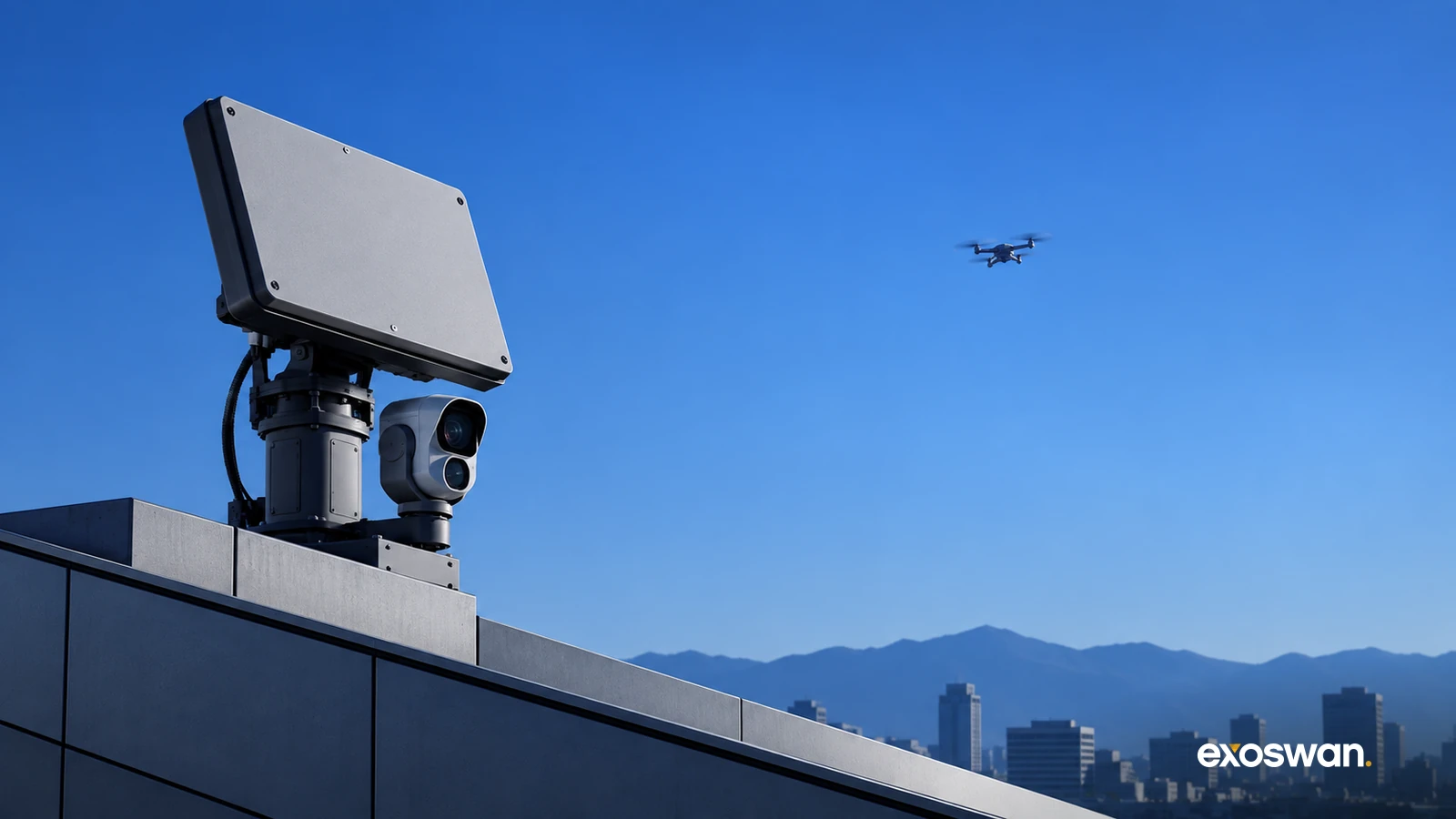
So the business of stopping drones is being rebuilt around a single number: the cost per kill. Every counter-drone system (C-UAS, in Pentagon shorthand) has the same three jobs. It finds the drone, works out what it is, and stops it. The stopping can happen a lot of ways. You can jam the drone's radio link, hijack its controls, hit it with a missile, a gun round, or a cheap interceptor drone, or burn it with a laser or a microwave pulse. Each option has its own price per kill, and that price now decides who wins contracts.
Washington is shopping at the cheap end. The Pentagon's 2027 budget request asks for $20.6 billion for counter-drone systems, more than five times this year's level, and calls specifically for "high-volume interceptors." Ukraine shows why. Cheap interceptor drones helped push the share of Russian attack drones that hit their targets below 7% in May, even as Russia launched a record number of them.
This list of anti-drone stocks runs down that cost curve, from weapons that cost almost nothing per shot to the sensors and software that decide which one to fire.
Companies at a glance
11 companies| Company | Ticker | Segment | Thesis |
|---|---|---|---|
| AeroVironment | NASDAQ: AVAV | Lasers & Microwaves | Holds the first U.S. production contract for a laser weapon |
| Elbit Systems | NASDAQ: ESLT | Lasers & Microwaves | Already booking laser sales |
| Epirus | Private | Lasers & Microwaves | One pulse, a whole swarm |
| RTX | NYSE: RTX | Volume Fire | The missile priced to be expendable |
| L3Harris | NYSE: LHX | Volume Fire | A drone killer that bolts onto a pickup |
| Rheinmetall | XETRA: RHM | Volume Fire | Guns are back, and Europe is buying |
| DroneShield | ASX: DRO | Jammers & Hijackers | Homeland contracts, if the money follows |
| Motorola Solutions | NYSE: MSI | Jammers & Hijackers | Police get the right to take drones down |
| Ondas | NASDAQ: ONDS | Jammers & Hijackers | The NFL started paying to stop drones |
| Leonardo DRS | NASDAQ: DRS | Sensors & Command | Every kill starts with a radar |
| Anduril | Private | Sensors & Command | The software that picks the shot |
Lasers & Microwaves
These weapons cost little more than electricity per shot. The hard part is getting them out of the lab and into production, and that's what these anti-drone stocks get judged on.
AeroVironment NASDAQ: AVAV
AeroVironment won what it calls the first production contract for high-energy laser weapons in U.S. history in September: up to $464.8 million for the Army to buy dozens of its 30-kilowatt LOCUST systems. Days later it landed its first international LOCUST order, worth more than $50 million.
The Army is funding the program in tranches, so the full contract won't land in one year. But AeroVironment now has something no other U.S. company has, which is a laser that the military is buying rather than testing.
Elbit Systems NASDAQ: ESLT
Elbit supplies the laser inside Iron Beam, the Israeli system that was handed to the military last December. Elbit says higher sales of its airborne and land high-power lasers in Asia-Pacific were the main reason one of its divisions grew 22% last quarter.
That makes Elbit the rare company where high-power lasers already move the numbers. Israel has been the proving ground for modern air defense since Iron Dome, and export orders tend to follow.
Epirus
Epirus builds Leonidas, a high-power microwave weapon that fries drone electronics in a cone instead of hitting one target at a time. In a 2025 demonstration it brought down a 49-drone swarm with a single pulse. In December it took down a fiber-optic drone, the kind that doesn't use radio and can't be jammed. A microwave doesn't care how a drone is controlled. The Marines signed an $11 million contract in August.
Volume Fire
Lasers can't do everything yet: clouds, range and power limit them. Until they can, the answer is cheaper ammunition fired in much bigger quantities, which is the business behind three of the largest anti-drone stocks.
RTX NYSE: RTX
RTX makes Coyote, a small interceptor built for drones, and the Army's 2027 request prices it at roughly $139,000 a round. That's not cheap, but it's a fraction of a Patriot. RTX says it has more than doubled Coyote output, and for a missile meant to be used up, output is the number that matters.
L3Harris NYSE: LHX
L3Harris sells VAMPIRE, a counter-drone kit that turns a pickup truck into a drone killer. It has logged more than 350,000 operational hours in combat in Europe since 2023. High-volume production started in Huntsville in March, the Army ordered up to $106 million worth in June, and the Navy picked it in September.
Rheinmetall XETRA: RHM
Rheinmetall is the bet that the cheapest kinetic kill is a gun. Its Skyranger systems put rapid-fire cannons with smart ammunition on armored vehicles, and European armies that let their short-range air defense wither after the Cold War are now ordering them.
Its air-defense orders in the first half of 2026 were more than six times the year before, and the division's backlog now tops €4 billion.
Jammers & Hijackers
These systems don't fire anything. They cut a drone's radio link or take over its controls, which is ideal near crowds and airports. The catch is that drones guided by fiber-optic cable don't use radio at all, and those are spreading on the battlefield.
DroneShield ASX: DRO
DroneShield is the pure-play on radio-frequency detection and jamming, and its next leg is American homeland security. On September 30, it won a Pentagon homeland-defense contract worth up to $500 million over three years.
Read that number carefully. AeroVironment and CACI have each announced their own $500 million contract under the same program, which had committed only about $158 million as of April. Each figure is a ceiling, not a check. DroneShield's revenue rose 74% in the first half, and whether that pace holds depends on how much of the ceiling turns into orders.
Motorola Solutions NYSE: MSI
Motorola Solutions already sells radios and software to most American police departments. In August it closed its $1.5 billion purchase of D-Fend, whose system takes control of a hostile drone and lands it safely instead of shooting it down.
The timing is the point. The Safer Skies Act, signed in December, lets trained state and local police take drones down for the first time. Motorola is selling the tool to customers who just got permission to use it.
Ondas NASDAQ: ONDS
Ondas owns Sentrycs, another cyber-takeover system. In August the Jacksonville Jaguars became the first NFL team to move from simply detecting drones to actually stopping them, using Sentrycs.
It's one team, but it's a signal. If stadiums, arenas and private venues start paying to mitigate drones rather than just watch them, the homeland market is much larger than military budgets alone.
Sensors & Command
No cheap weapon works against every drone in every condition. Somebody has to find the target and pick the right tool for each shot.
Leonardo DRS NASDAQ: DRS
Leonardo DRS makes the tactical radars that find small drones before anything gets fired at them. Its revenue growth this year has been led by those radars, and international sales rose to 12% of revenue from 8%, which DRS partly credits to global demand for counter-drone and short-range air defense. Radar is the one layer every approach needs, whether the shot comes from a laser, a gun or a jammer.
Anduril
Anduril builds interceptors and sensors, but the piece that matters here is Lattice, its command-and-control software. Lattice ties sensors and weapons from different vendors into one picture and helps decide which one engages. In March the Army placed an $87 million counter-drone order, the first under a new enterprise agreement with Anduril. There's no public IPO filing yet.
The Future of Anti-Drone Systems
Every cheap kill has a weak spot. Lasers struggle in cloud and haze. Jammers can't touch fiber-optic drones. Guns run out of range. Microwaves need power and have to get close. Interceptor drones can't catch the fastest jet-powered drones.
So the defense of 2027 isn't one weapon. It's a stack of them, and the expensive mistake is firing the wrong one. Each threat needs the cheapest tool that will work on it, chosen in seconds and usually by software.
That shifts where the money settles. Weapons will get cheaper and more interchangeable, with more suppliers fighting over each layer. The scarce piece becomes the software that sees the whole sky and decides which weapon fires. Among anti-drone stocks, the most valuable company may end up being the one that never fires a shot.