
For three years, AI has been a brain in a jar.
We gave it language. We gave it vision. We gave it the ability to write code, pass the bar exam, and generate photorealistic images of astronauts on horseback. Remarkable. But all of it happens on a flat screen, inside a browser tab.
The problem is that the vast majority of the global economy doesn't live in a browser tab. It lives in warehouses, on construction sites, inside surgical suites, and across millions of miles of aging infrastructure.
If a chatbot predicts the next word, a physical AI model must predict the next state of the world, accounting for gravity, friction, occlusion, and a forklift that just turned the corner.
That prediction requires a spatial layer: sensors that build a real-time 3D model, software that makes that model persistent and simulatable, and silicon that can run inference on the device. Strip any one of these away, and the robot is blind, hallucinating, or too slow to matter.
Jensen Huang put it plainly at CES 2026: "The ChatGPT moment for physical AI is here."
If he's right, the companies building the spatial computing stack—the eyes, the maps, the simulators, and the edge brains—are the next critical infrastructure bet.
This report maps the investable terrain of spatial computing stocks.
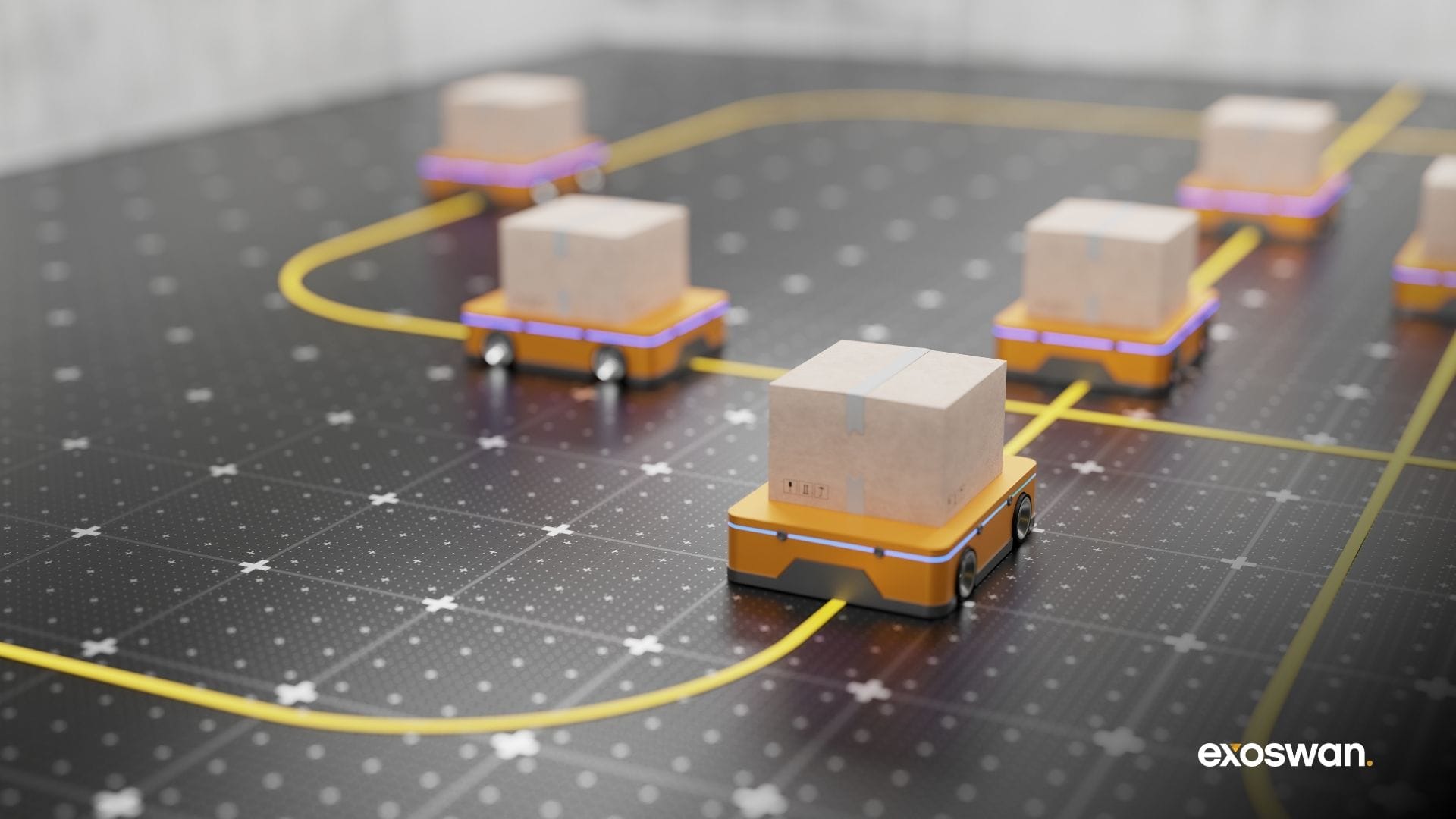
Sensing the Physical World
Every physical AI system begins with the same question: What's around me?
Before a robot can pick up a box, navigate a corridor, or avoid a person, it needs a millimeter-accurate, real-time 3D model of its environment. This is the “volumetric point cloud,” capturing depth, distance, velocity, all at once.
- Ouster (NASDAQ: OUST) is assembling what may be the most complete perception platform for physical AI outside the megacaps. Its digital lidar sensors generate up to 5.2 million points per second—dense enough 3D data for autonomous machines to navigate safely. But the defining move was its February 2026 acquisition of Stereolabs, a leading maker of industrial stereo cameras and edge AI compute modules. The combined entity now offers lidar, cameras, AI processing, sensor fusion, and perception software under a single roof. Ouster becomes the "just plug it in" answer for anyone building an autonomous forklift, a robotaxi, or a security perimeter.
- Cognex (NASDAQ: CGNX) builds the AI-powered eyes that sit on factory lines: guiding robotic arms, inspecting products, reading barcodes at blinding speed. It's been doing this for four decades and holds a roughly $7 billion addressable market. The shift underway: logistics surpassed all other verticals as its largest revenue contributor in 2025, and its new SLX portfolio of application-specific, AI-enabled vision devices for warehouses signals a push from fixed inspection toward mobile robotic guidance.
Digital Twins and Spatial Intelligence
Seeing the world is step one. Understanding it—with a persistent, updatable, physics-aware model—is step two. This is the domain of digital twins: millimeter-accurate living replicas of real-world infrastructure that allow operators to simulate changes before pouring concrete or moving machinery.
- Bentley Systems (NASDAQ: BSY) is sometimes miscategorized as a legacy CAD vendor. Its real thesis now revolves around the iTwin platform—a cloud-based system that federates engineering data from dozens of sources into a single, AI-ready 4D digital twin (three spatial dimensions plus time). The value proposition solves a massive data-loss problem: historically, engineering models were discarded the moment a building was finished. iTwin makes the digital twin persist through the entire lifecycle of an asset, from design to construction to decades of operation.
- Trimble (NASDAQ: TRMB) attacks the same problem from the dirt. Where Bentley starts in the engineering office, Trimble starts at the construction site—with GPS, laser scanners, total stations, and reality-capture hardware—then flows that spatial data into connected software workflows. Its pivot to software now drives 79% of revenue and has pushed gross margins to a record 74.6%. But the 2026 catalyst is Trimble Agent Studio, an agentic AI platform for design, scheduling, and construction management. The thesis: if you control the precise digital record of how the physical world was built, you control the training data for the AI that will manage it.
Edge Vision Processors
Cloud latency is a luxury a robot arm moving at speed simply cannot afford. Physical AI demands inference at the edge: on the device, in real-time, at power budgets measured in single-digit watts. This is where the silicon specialists live.
- Ambarella (NASDAQ: AMBA) is the purest play on edge AI vision silicon. Its systems-on-chip power everything from security cameras to ADAS systems to autonomous robots, running deep neural network inference on-device at remarkably low power. The new CV7, launched at CES 2026 on a 4nm process, delivers 2.5x the AI performance of its predecessor while handling simultaneous multi-stream 8K video. Ambarella has shipped over 36 million edge AI processors to date. Fiscal year 2026 revenue grew 37% year-over-year. The thesis: if every robot, drone, and autonomous vehicle needs a vision processor that can think locally, Ambarella's power-per-watt moat is the one to beat.
- Lattice Semiconductor (NASDAQ: LSCC) plays a different but equally critical role. Its low-power FPGAs act as "companion chips"—programmable glue logic that bridges incompatible sensors, handles security functions, and manages board-level intelligence alongside the main processor. In the messy world of industrial vision, standards change constantly. A warehouse robot might need to interface with a Sony sensor today and a Teledyne sensor tomorrow. Lattice chips are the flexible connective tissue that bridges these mismatches with near-zero latency. The company is now reporting design wins in industrial robotics, humanoid robots, and robotaxis, with server revenue up ~85% year-over-year in FY2025.
- CEVA (NASDAQ: CEVA) is the IP licensing play. CEVA doesn't make chips; it licenses the DSP and NPU architectures that other chipmakers embed into their silicon for always-on sensing and ultra-low-power inference. Think of it as the invisible blueprint inside billions of connected devices. In 2025, AI crossed 20% of CEVA's licensing revenue for the first time, including a strategic agreement with Microchip Technology to embed CEVA NPUs across Microchip's massive microcontroller portfolio.
Private Bellwethers: World Models
Here's the fundamental bottleneck for robotics: you can't train a robot in the real world at scale. It's too slow, too expensive, and too dangerous. You need a simulated world to generate the millions of scenarios a robot requires before it touches a single real object.
For decades, researchers struggled with the "sim-to-real gap" because robots trained in simplified simulators failed spectacularly when confronted with the messy complexity of actual kitchens and actual warehouses. The new generation of world models—AI systems that predict how physical environments evolve, accounting for geometry, physics, and object permanence—is the attempt to close that gap.
This is where the biggest private-market bets are landing.
- World Labs (~$5 billion valuation, $1.23 billion raised, backed by NVIDIA, AMD, Autodesk, Fidelity) is the marquee name in spatial AI. Founded by Fei-Fei Li, the Stanford professor who created ImageNet and catalyzed the deep learning revolution, World Labs builds Large World Models that generate persistent, editable, physics-aware 3D environments from text, images, or video. Its first product, Marble, shipped in November 2025. Its World API, launched in January 2026, integrates directly with NVIDIA Isaac Sim, MuJoCo, and RoboSuite—meaning robotics developers can programmatically generate thousands of training environments instead of hand-building each one.
- Physical Intelligence (π) ($5.6 billion valuation, $1.1 billion raised, led by CapitalG, Lux Capital, Jeff Bezos, Sequoia) is building the complementary piece: a "single generalist brain" for robotics. Where World Labs simulates worlds, π acts in them. Its open-source π0 model uses a vision-language-action architecture: the robot sees the environment, understands a natural-language instruction, and generates continuous motor commands in real-time. Demonstrations include folding unseen laundry, assembling boxes, and cleaning kitchens the model has never encountered. Co-founded by researchers from Stanford, Berkeley, Google DeepMind, and Tesla, π represents the foundation-model paradigm applied to physical manipulation.
- AMI Labs (~€890 million raised, March 2026) is Yann LeCun's bet. The Turing Award winner and former Meta chief AI scientist has long argued that world models, not LLMs, are the prerequisite for human-level intelligence. AMI Labs is pursuing his JEPA architecture (Joint Embedding Predictive Architecture), which learns by predicting the state of a physical environment rather than generating tokens. This is fundamental research with a multi-year horizon. But the investor roster (Bezos Expeditions, Eric Schmidt, Xavier Niel) and the sheer scale of the raise signal that the world-model thesis is approaching consensus among deep-pocketed capital allocators.
Signals to Watch
For those tracking spatial computing stocks, here are the near-term signals that matter:
- The world model funding surge. Over $3 billion has flowed into world model and spatial AI startups in early 2026 alone. This capital creates downstream demand for 3D sensors, edge processors, and simulation-grade digital twins across the entire stack listed above.
- Humanoid robotics hitting pilot scale. Apptronik, Figure AI, Agility Robotics, and others are moving from demos to commercial deployments. Each humanoid in a warehouse is a spatial computing system on legs; it needs lidar, cameras, edge silicon, and a world model to train on. The humanoid boom is a spatial computing boom.
- The Ouster + Stereolabs integration. If Ouster delivers a unified perception platform that works out of the box, it becomes the default hardware stack for mid-market robotics companies that can't afford to build their own. Watch cross-sell traction in Q2–Q3 2026.
- Agentic AI inside digital twins. Both Trimble and Bentley are deploying AI agents within their spatial platforms this year. If agents can autonomously monitor construction, flag anomalies, or optimize energy usage inside a living digital twin, the value of spatial data compounds exponentially.
- NVIDIA's Cosmos and GR00T expansion. NVIDIA's world foundation models, trained on 20 million hours of real-world video, are the gravitational center. Every robotics company building on Isaac Sim creates pull-through demand for sensing, edge compute, and simulation tools.
The smartphone era compressed the entire digital world into a pocket-sized rectangle. Spatial computing is the thesis that we're about to decompress it—spreading data across walls, workbenches, and the open air.
The rectangle served us well for forty years. But the world is three-dimensional, and computing is finally about to be, too.