
Imagine spending seventy years perfecting an engine, only to discover you've been leaving half the fuel in the tank.
That's the solar industry today. Crystalline silicon panels, the technology behind virtually every rooftop and solar farm on Earth, can only capture a fraction of the total light spectrum. The best commercial panels convert about 24% of sunlight into electricity.
Physics says a single-junction silicon cell will never do much better than 30%. After decades of refinement, the industry is bumping against that hard ceiling.
Perovskite breaks through it.
Perovskite is a class of crystal, cheap and abundant, that absorbs a different slice of the solar spectrum than silicon does. Stack a perovskite layer on top of a silicon cell, and you get a tandem: a device that captures both the blue light silicon misses and the red light it's good at.
The theoretical ceiling of a tandem jumps above 43%. In the lab, LONGi has already hit 34.85%. This is arguably the biggest jump in solar physics since the technology was invented by Bell Labs in 1954.
The catch: perovskite is fragile. It degrades when exposed to moisture, heat, and UV—the three things solar panels encounter every day. Solving that durability problem at industrial scale is the central challenge, and it's why this market is still early.
The perovskite supply chain is split across the U.S., Europe, China, Japan, and South Korea. This report highlights the top perovskite stocks to watch, grouped by their role in the value chain.
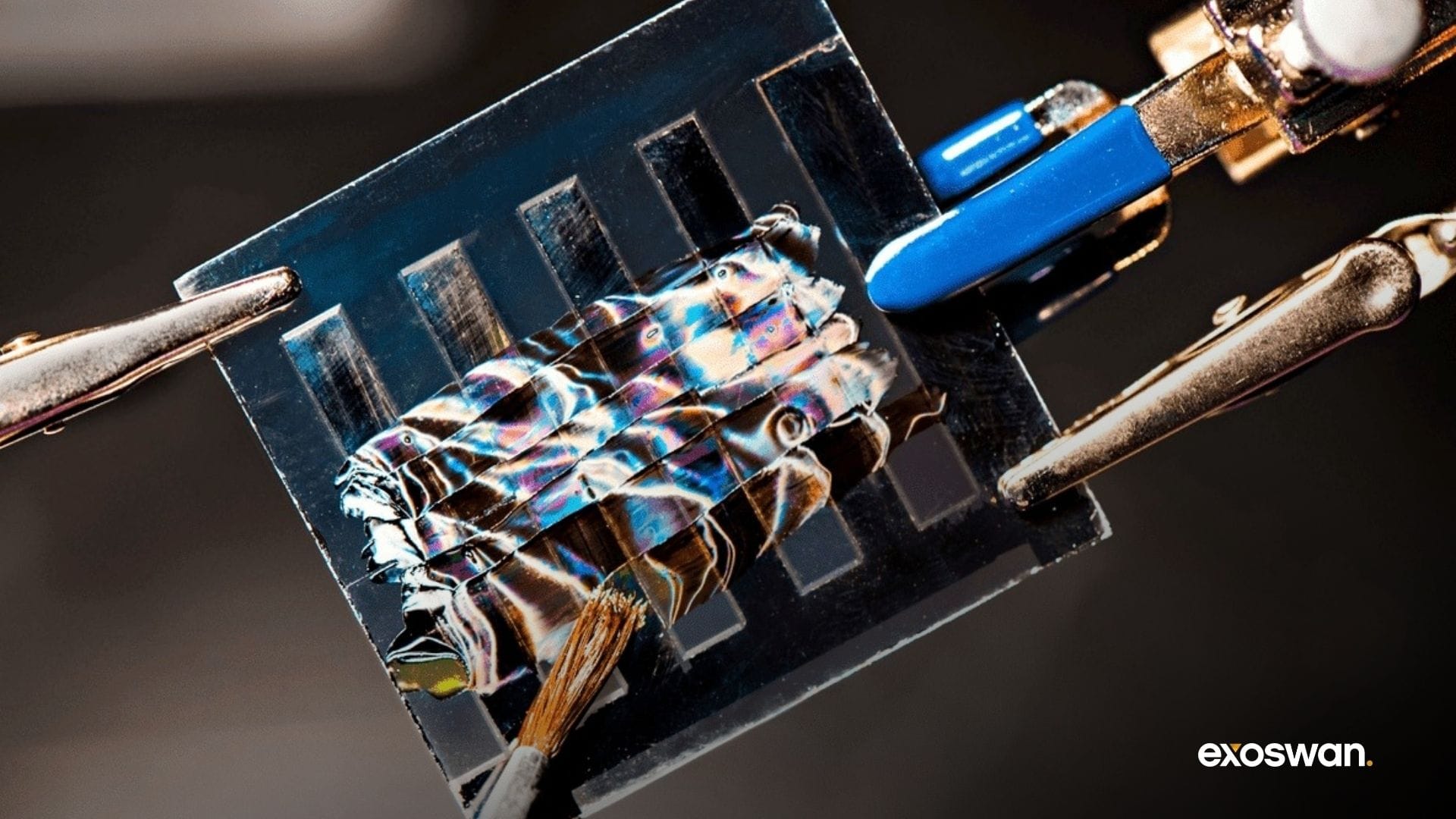
Perovskite IP
Every perovskite-silicon tandem cell needs a perovskite layer deposited onto silicon. That sounds simple, but the recipes, processes, and architectures required to make it work—and last—are buried under a thicket of patents.
Currently, one company dominates.
- Oxford PV ($239 million raised, private) shipped the world's first commercial tandem modules in September 2024 and holds over 400 patents—the strongest perovskite IP portfolio globally. It has licensed its technology to Trina Solar for China and to First Solar for the U.S. Think ARM Holdings: Oxford PV may never build the biggest factories, but every manufacturer may need its permission to operate. The highest-profile IPO candidate in the space.
Silicon-Perovskite Tandem Cell Makers
The most likely near-term winners are the silicon incumbents who already have the factories, the customer relationships, and the bankability to convert existing production lines to tandem. The race here is about who can layer perovskite onto their silicon platform fastest and prove it lasts 25 years in the field.
- LONGi Green Energy (SHA: 601012) holds the world record for tandem cell efficiency at 34.85% and the large-area record at 33% on a device sized for mass production. LONGi is the world's largest solar manufacturer. It hasn't shipped tandem modules yet, but its scale means that when it does, the ramp will dwarf everyone else's.
- Hanwha Solutions (KRX: 009830), via its Qcells division, hit 28.6% tandem cell efficiency on a commercial-size wafer using only mass-production processes, and its modules have passed IEC/UL stability tests. Commercial production is planned for 2026, with mass production H1 2027. Qcells' edge: it plans to convert its existing silicon lines to tandem rather than build from scratch. In 2026, Hanwha will be the only company in North America producing every component of a solar panel, from ingot to finished module. Qcells is not separately listed; investors access it through Hanwha Solutions on the Korea Exchange.
- JinkoSolar (NYSE: JKS) hit 33.84% on a TOPCon-based tandem cell in January 2025. As the world's top module shipper by volume, even a modest tandem uplift could move gigawatts. Trina Solar (SHA: 688599) signed an exclusive Oxford PV patent license for China and demonstrated an 808W tandem module certified by TÜV SÜD. Both are signaling that perovskite is not optional for their roadmaps.
- Enel (BIT: ENEL), through its 3Sun Gigafactory in Catania, Sicily, is ramping 3 GW of annual capacity and collaborating with France's CEA-INES, which has yielded a 30.8% tandem cell. The plan: HJT panels today, perovskite-silicon tandems in 2026, targeting modules above 30%. 3Sun is backed by €600 million including EU grants.
Perovskite Thin-Films
Most of the tandem race is about adding perovskite to silicon. But there's a parallel path: using perovskite as a standalone thin film, or pairing it with non-silicon substrates like cadmium telluride. This is the domain of companies whose manufacturing DNA is in coatings and films, not wafers.
- First Solar (NASDAQ: FSLR) is the only large Western solar manufacturer with thin-film DNA. It acquired Swedish perovskite specialist Evolar in 2023, built a dedicated perovskite development line in Ohio, and in February 2026 licensed Oxford PV's patent portfolio for U.S. markets. With $5.2 billion in 2025 sales, ~18 GW of U.S. capacity by 2027, and over $2 billion invested in thin-film R&D, First Solar hasn't shipped a perovskite product yet—but when it does, no startup can match its manufacturing muscle or IRA-credit tailwinds.
- Sekisui Chemical (TYO: 4204) is the dark horse, a Japanese chemicals conglomerate developing flexible, film-type perovskite cells for surfaces where rigid panels can't go: facades, curved rooftops, lightweight structures. It has committed roughly $2 billion to reach 1 GW of output by 2030, backed by over $1 billion in Japanese government subsidies. The bet here is that perovskite film creates an entirely new building-integrated PV market that silicon can't address.
- Renshine Solar (Changshu, China; private; $171 million invested) is pursuing the most radical path: all-perovskite tandems: perovskite-on-perovskite, no silicon at all. If it works at scale, this is could be highly disruptive, as it eliminates silicon from the equation entirely.
China’s Gigawatt Factories
Lab records grab headlines. But the real inflection point is when someone builds a factory that churns out perovskite panels at silicon-like volumes. That threshold was crossed in 2025, but in China, not the West.
- GCL Technology Holdings (HKEX: 3800) is the parent of GCL Optoelectronics, which opened what it calls the world's first gigawatt-scale perovskite factory in Kunshan, China, in June 2025—a $700 million facility producing the largest commercial perovskite panels to date (2.76 m²) at a certified 29.51% module efficiency. The perovskite unit is being positioned for a separate listing. If it IPOs, it would become the first publicly traded pure-play perovskite company.
- UtmoLight (Wuxi, China; private) launched a 1 GW production line in February 2025 and already offers a 25-year power output guarantee. a milestone that few peers can match. Its modules are deployed in commercial projects across multiple Chinese provinces.
- Microquanta Semiconductor (Hangzhou, China; private) operates a 100 MW line and in late 2024 grid-connected the world's largest perovskite solar farm at 8.6 MW. It serves as proof that single-junction perovskite (no silicon needed) can work at field scale.
The gap between Chinese and Western manufacturing capacity is the most important structural fact in this market. GCL, UtmoLight, and Microquanta are already shipping to real projects. No Western company has a gigawatt-scale perovskite line under construction yet.
U.S. Perovskite Startups
The American perovskite ecosystem is smaller and earlier than China's, but it has a structural advantage: the Inflation Reduction Act's manufacturing credits, tariff protection, and rising demand for a domestic solar supply chain. These startups are racing to prove tandem technology works before the policy window closes.
- Swift Solar ($44 million+ raised) in March 2026 acquired Meyer Burger's HJT manufacturing assets and patent portfolio after the Swiss manufacturer went bankrupt. In one move, Swift Solar gained GW-scale equipment, the largest HJT IP portfolio in the West, and Meyer Burger's former CEO and R&D chief. The strategy: build a U.S. HJT factory first, then layer perovskite on top.
- Tandem PV ($87 million raised) is building a U.S. factory after a $50 million Series A in 2025. Its CTO built the first perovskite-silicon tandem cell at Stanford. Current panel efficiencies of 28%, targeting utility-scale customers in 2026.
- Caelux ($24 million+ raised) takes a shortcut: its "Active Glass" replaces the front glass of any existing silicon panel with perovskite-coated glass, creating an instant hybrid tandem. First commercial shipment in July 2025. If it works at scale, this could be the fastest route to tandem adoption, with no new factories required.
- CubicPV ($100 million+ raised, backed by Breakthrough Energy Ventures) merged silicon wafer IP with perovskite R&D and hit a 24% mini-module record with NREL. It has a deal to supply next-gen cells to India's Waaree for a 2 GW production plan.
Alternative Perovskite Architectures
Most of the industry is converging on two-terminal perovskite-on-silicon tandems. But a few players are betting on different designs that could leapfrog the consensus approach.
- EneCoat Technologies (Kyoto, Japan; private) hit 30.4% efficiency on a four-terminal tandem developed with Toyota. Four-terminal designs are more complex but allow each cell to operate independently, leading to potentially better performance in variable light conditions. This is a Kyoto University spinoff representing Japan's bet on a different tandem architecture.
- Aixtron (NASDAQ: AIXG) is a speculative equipment play. Its vapor deposition systems are relevant to perovskite manufacturing, and it participates in perovskite research. But perovskite production equipment is still largely custom-built by the cell makers; no dominant supplier has emerged yet, making this a bet on the process route rather than the outcome.
Signals to Watch
For those tracking perovskite solar stocks, here are the near-term signals that matter:
- The durability threshold. Utility-scale project finance typically demands 25-year warranties. Oxford PV currently offers 10 years, targeting 20 years in 2026. UtmoLight already guarantees 25 years of power output. Watch for Western producers to cross the 20-year mark; that's the inflection point for bankability.
- The IP chess game. Oxford PV has now licensed its patents to both Trina (China) and First Solar (U.S.). If every tandem manufacturer needs Oxford PV's permission to ship, this becomes a Qualcomm-style licensing layer. It’s recurring revenue for Oxford PV, but a bottleneck and litigation risk for everyone else.
- China's manufacturing lead. GCL, UtmoLight, and Microquanta are already shipping perovskite modules to real projects. No Western company is close. The question for First Solar and Swift Solar: can tariffs and IRA credits buy enough time to build competitive domestic capacity?
- The 30% commercial module. Shipped tandem modules today top out around 24–26%. The first company to break 30% on a certified, warrantied commercial product will trigger a repricing event across the entire solar value chain. Enel's 3Sun and Qcells are the likeliest candidates in 2026–2027.
- The GCL Optoelectronics IPO. If GCL lists its perovskite subsidiary, it becomes the world's first publicly traded pure-play perovskite company—a landmark for the sector and a signal for every private perovskite company eyeing the public markets.
Silicon spent seventy years getting to 25%. Perovskite has blown past it in a decade. The question is no longer if the solar industry transitions; it's who captures the margin on the other side.