
Picture building a state-of-the-art airport, only to realize the airlines can't afford the fuel to fly there. That's roughly where green hydrogen sits today.
The technology works. Electrolyzers can split water into hydrogen and oxygen using renewable electricity. The physics is settled. What isn't settled is the economics—and right now, they’re brutal.
In 2025, close to 60 major hydrogen projects were cancelled, wiping out nearly five million tonnes of planned annual production. BP walked away from a 1.5 GW project in Oman. Air Products wrote off up to $3.1 billion exiting three U.S. projects. One Australian developer literally dismantled its plant and returned the government's money.
The core problem is a viability gap: it costs $4–6 to produce a kilogram of green hydrogen; buyers will pay $1–2. The IEA estimates only 4–6 million of the 37 million tonnes announced in project pipelines will actually materialize by 2030. Grey hydrogen (the cheap, fossil-derived kind) still accounts for over 95% of supply.
So why still track it?
Because troughs of disillusionment are often where value chains quietly get built. The speculative froth is gone. What remains are companies with actual technology, contracts, and revenue.
More importantly, structural forces are building behind them: the EU's Carbon Border Adjustment Mechanism (CBAM) now imposes real costs on carbon-intensive imports. China elevated hydrogen to a central priority in its 15th Five-Year Plan. And the world's largest green hydrogen plant—the $8.4 billion NEOM Green Hydrogen project in Saudi Arabia—is over 90% complete, with first production expected in 2027.
The key question right now is who survives the valley of death. This report highlights the top green hydrogen stocks to watch across different segments of the value chain.
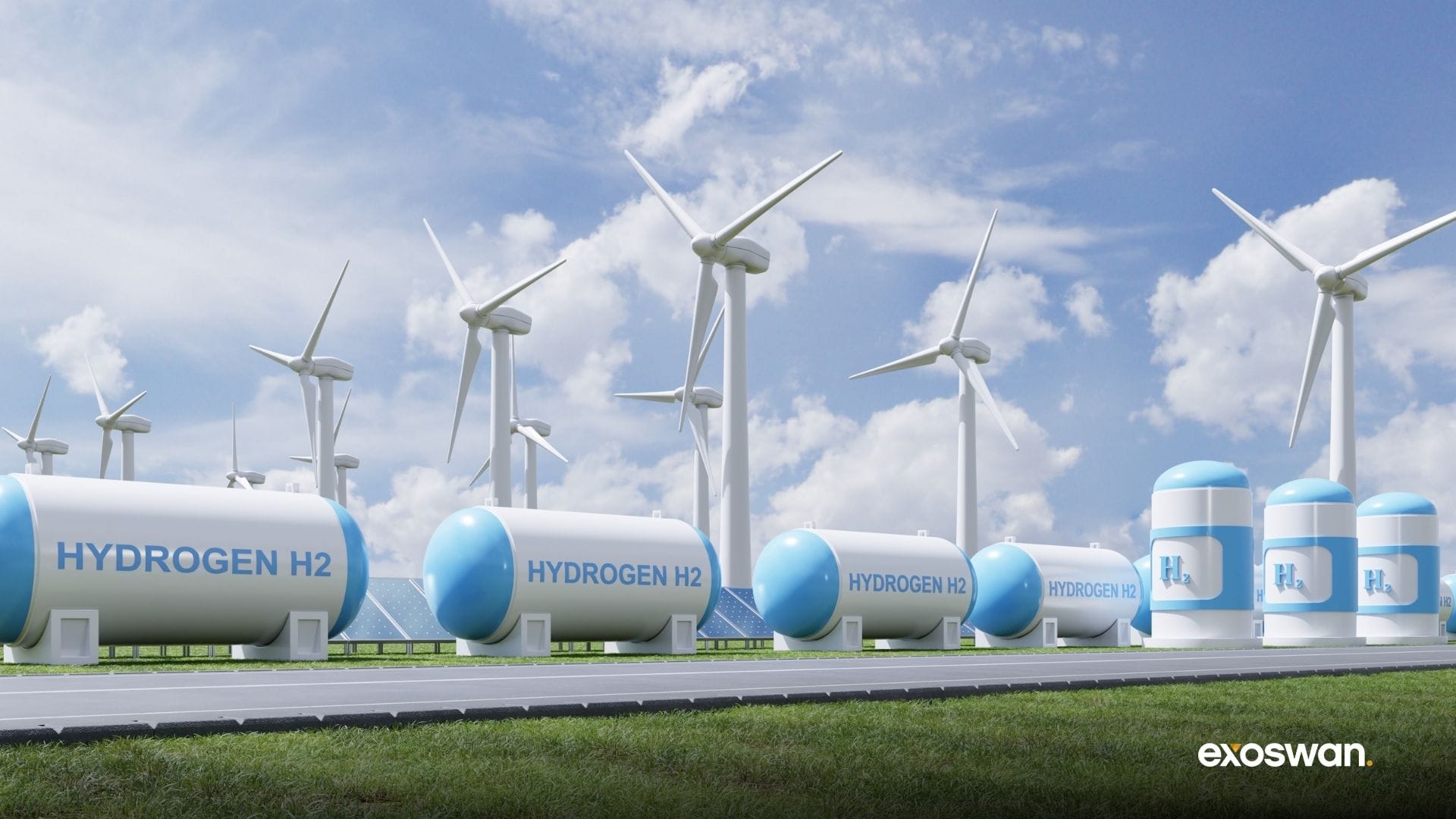
Hydrogen Electrolyzers
An electrolyzer splits water into hydrogen and oxygen. When powered by renewables, the hydrogen it produces is "green." These are the picks and shovels of the industry—but right now, the gold rush hasn't actually started.
Overcapacity is building, order books are thinning, and Chinese equipment priced at a quarter of Western equivalents has flooded the market.
- thyssenkrupp nucera (ETR: NCH2) holds the strongest hand. It is the electrolyzer supplier behind the NEOM megaproject for over 2 GW of capacity. Now 90% complete, this would be the single most important proof point in the industry. Nucera's profitable chlor-alkali business provides a financial cushion that pure-play hydrogen firms don't have. But even nucera isn't immune: Q1 sales dropped 44%, and it cut full-year revenue guidance to €450–550 million on March 17. Real technology, real projects—but "withstand" is the operative word.
- NEL ASA (OSE: NEL) is the Norwegian veteran most investors associate with hydrogen. After spinning off its fueling division into Cavendish Hydrogen (OSE: CAVEN) in mid-2024, NEL is now a pure-play electrolyzer company. The streamlining hasn't been enough: trailing revenue sits around $93 million, the market cap has shrunk to ~$400 million, and the order inflection investors have waited years for hasn't arrived. Deep expertise, dwindling credibility. Speculative at best.
- Cummins / Accelera (NYSE: CMI) is no longer a hydrogen play; it's now a warning sign. In February 2026, Cummins halted all new electrolyzer sales, took $458 million in charges, and began cutting jobs at its Belgian plant. CEO Jennifer Rumsey: "The demand for green hydrogen has dried up, dramatically lower." This from a company that projected $400 million in electrolyzer revenue by 2025 at its 2020 "Hydrogen Day." We include Cummins here purely as a bellwether—its exit tells you where the industry's cycle clock is pointing.
Hydrogen Fuel Cells
Fuel cells convert hydrogen back into electricity, the demand side of the equation. The landscape has diverged sharply, with one company finding product-market fit. The others are still looking.
- Bloom Energy (NYSE: BE) is the breakout, though not strictly a hydrogen story. Its solid oxide fuel cells run primarily on natural gas today, providing on-site power for AI data centers. FY2025 revenue hit $2.02 billion (up 37%), and guidance calls for $3.1–$3.3 billion in 2026. American Electric Power signed a deal worth up to $2.65 billion. Bloom's platform can run on hydrogen, positioning it as a bridge to the future, but at ~125x forward earnings, the stock is priced for the AI power story, not the hydrogen one.
- Plug Power (NASDAQ: PLUG) is the cautionary tale. Over two decades building a vertically integrated hydrogen ecosystem, and never an annual operating profit. Shares collapsed from above $75 to ~$2.33; a mid-2025 dip even triggered a Nasdaq delisting scare. There are recent glimmers—Q4 2025 showed Plug's first gross profit in years, new CEO Jose Luis Crespo took over in March 2026, and FY2025 revenue came in at $710 million—but cash burn exceeded and a class action lawsuit remains unresolved. Approach with extreme caution.
Industrial Gas Incumbents
The companies most likely to commercialize green hydrogen at scale are the industrial gas giants that already produce, transport, and sell millions of tonnes of grey hydrogen every day. They have the pipelines, the customers, and the balance sheets. They just need the economics to work.
- Air Products (NYSE: APD) is the purest large-cap play—builder, system integrator, and exclusive 30-year offtaker for all green ammonia from the NEOM project. The facility integrates 4 GW of renewables to export 1.2 million tonnes/year of green ammonia, and Air Products is in advanced talks with Yara to distribute it globally. But it also wrote off $3.1 billion while exiting three U.S. projects. NEOM is the crown jewel; everything else is being rationalized.
- Linde (NYSE: LIN) and Air Liquide (EPA: AI) are the other two pillars of the industrial gas oligopoly. Both produce hydrogen at massive scale (overwhelmingly grey, for now) and have the pipeline infrastructure to distribute green hydrogen when the economics arrive. They are not making big public bets on timelines. These are dividend-paying businesses with hydrogen optionality built in.
Private Bellwethers
These are the venture-backed green hydrogen companies. Watch them as IPO candidates, acquisition targets, or signals of where the technology is heading.
- Electric Hydrogen (EH2) is the sector's first unicorn ($1 billion valuation, $776 million raised, backed by Microsoft, BP, Fortescue, and United Airlines). Founded by two former First Solar CTOs, EH2 builds its entire electrolyzer stack in-house and sells hardware to project developers. It recently acquired developer Ambient Fuels and established a $400 million project finance facility with Generate Capital, positioning itself to finance the buildout.
- Sunfire (Dresden, Germany) builds solid oxide electrolyzers that operate at high temperatures for greater efficiency, potentially critical for integration with industrial heat processes like steelmaking and chemicals.
- H2Pro (Israel) is developing a fundamentally different water-splitting method that claims over 95% efficiency by eliminating the expensive membrane in conventional electrolyzers. Still early, but if it delivers, it could reshape the cost equation.
Signals to Watch
For those tracking green hydrogen stocks, here are the near-term signals that matter:
- NEOM commissioning. Solar and wind assets targeting completion by mid-2026; first ammonia now expected 2027, slipping from the original end-of-2026 target. If NEOM delivers, it validates the entire value chain at unprecedented scale. If it slips further, it sets the narrative back years.
- Offtake agreements. The single biggest bottleneck is demand, not technology. The industry needs binding, long-term purchase contracts with industrial buyers willing to pay above fossil benchmarks. Every signed deal is a signal. Every month without one is a warning.
- CBAM enforcement. The EU's carbon border tax is now live on imports of steel, cement, aluminum, and fertilizers. If it changes procurement decisions, it creates the demand pull green hydrogen has been missing.
- China's 15th Five-Year Plan. China built more green hydrogen capacity in 2025 than any other country, and its electrolyzers cost ~75% less than Western equivalents. If China does to hydrogen what it did to solar panels, the cost curve collapses and Western manufacturers face existential pricing pressure.
- U.S. policy clarity. Air Products cancelled its Massena project over tax credit uncertainty. Cummins exited electrolyzers entirely. The fate of 45V production credits will determine whether the U.S. is a player or a spectator.
- The industrial retreat or re-entry. Cummins' exit is a defining moment. If others follow, the Western supply chain narrows dangerously. If it's the bottom, the companies that held their nerve will have the field to themselves.
The hype cycle has broken. The companies still standing know exactly how hard this is. The trough of disillusionment is here, while the real foundations get poured.
The airport is being built. The question is how long before the planes arrive.